Education CRM vs ERP: What’s the Difference and What Do Educational Institutions Really Need?
Educational institutions today manage far more than admissions and academic records. Schools, colleges, universities, coaching centres, and education consultancies must handle student inquiries, admissions, communication, fee collection, academic operations, marketing campaigns, reporting, and stakeholder engagement simultaneously.
As institutions become increasingly digital, two software categories often dominate technology discussions: Education CRM and ERP systems. While both platforms help streamline operations, they serve very different purposes
Many institutions searching for the right technology solution often ask whether they need a CRM, an ERP, or both. Understanding the differences between these systems is essential for making informed decisions that support student recruitment, operational efficiency, and long-term institutional growth. Implementing the right education CRM software can help institutions streamline admissions, improve student engagement, and enhance enrollment outcomes.
Why Educational Institutions Need Digital Management Systems
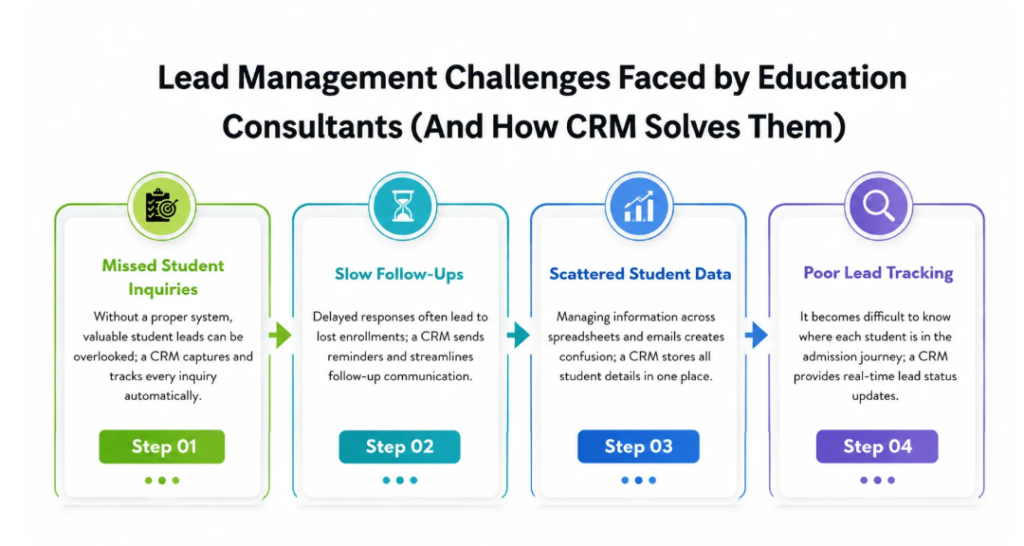
The modern student journey begins long before enrollment. Prospective students interact with websites, social media platforms, education portals, WhatsApp, email campaigns, webinars, and counselors before making admission decisions.
At the same time, institutions must manage academics, finance, examinations, attendance, faculty operations, student records, and administrative processes.
Managing these functions manually often leads to:
- Lost student inquiries
- Delayed follow-ups
- Disconnected data
- Inefficient communication
- Limited visibility into admissions performance
- Operational bottlenecks
This is where technologies like education CRM software and ERP systems help institutions centralize processes and improve efficiency.
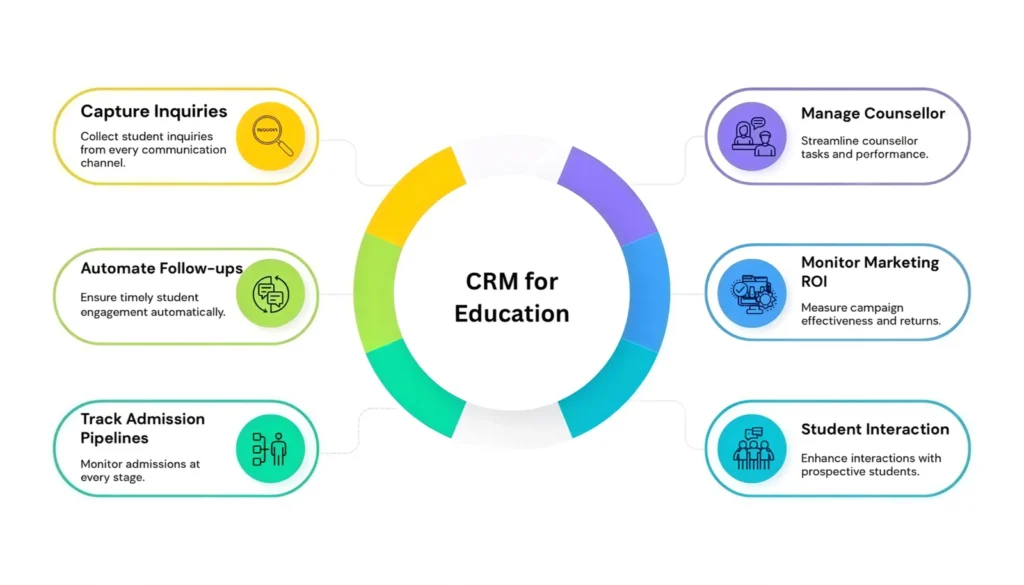
What Is CRM for Education?
This is one of the most common questions educational institutions ask.
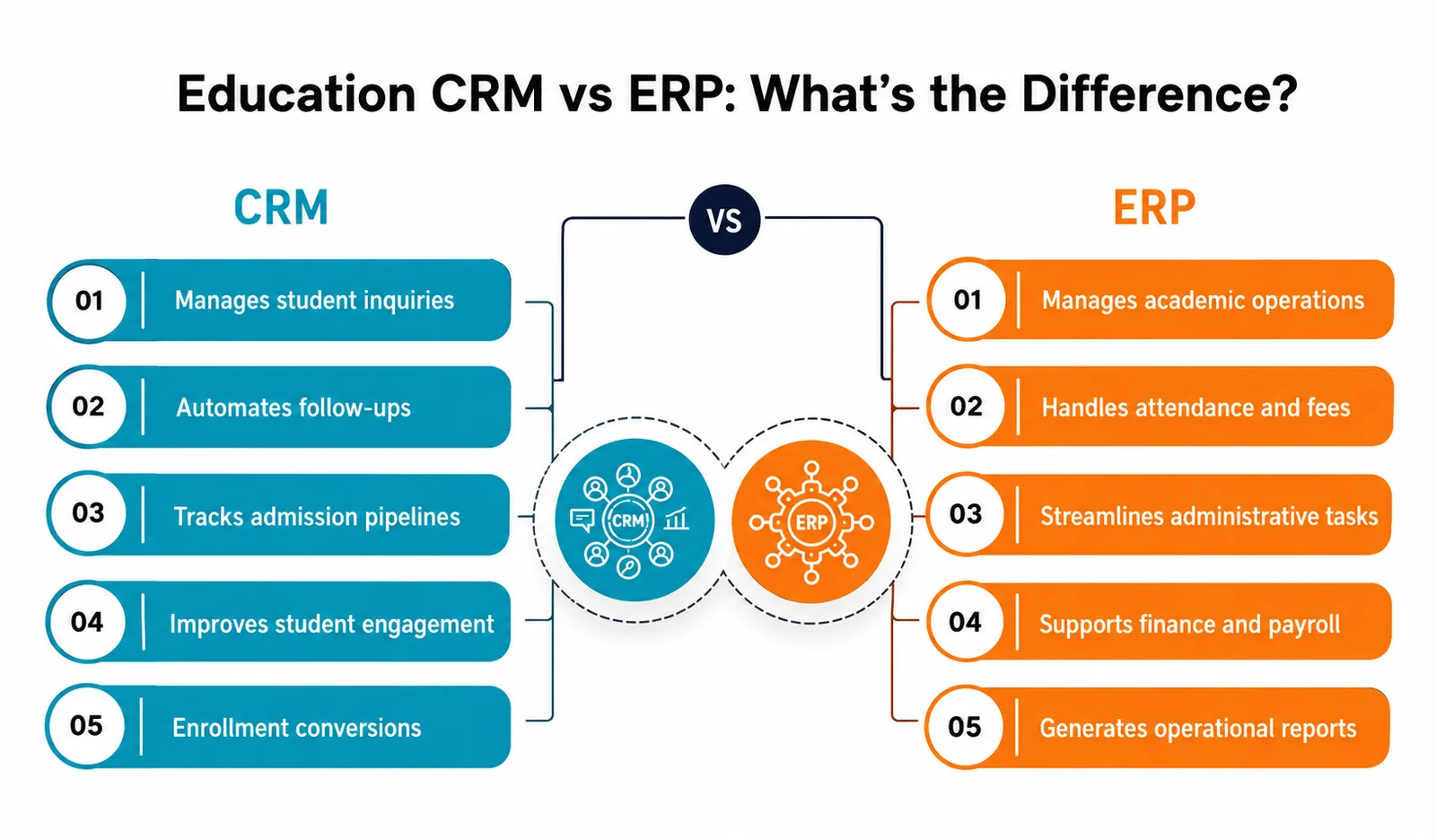
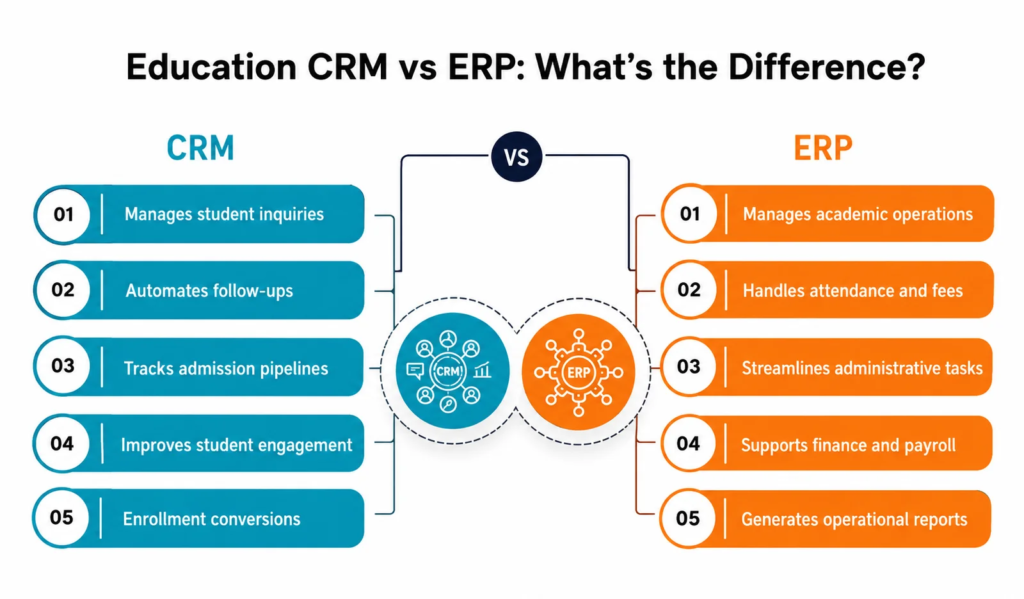
A Customer Relationship Management (CRM) system designed for education focuses primarily on student recruitment, admissions, communication, lead management, and relationship building.
An education CRM helps institutions manage prospective student interactions from the first inquiry through enrollment and beyond.
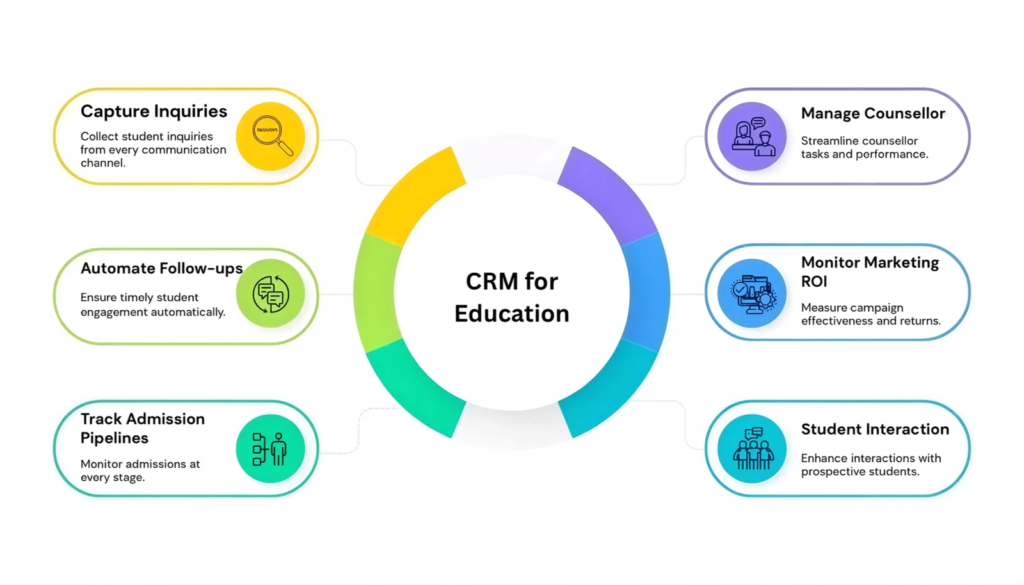
Unlike traditional business CRMs, a CRM for education industry is specifically designed to support admission workflows, student engagement, counselor management, marketing campaigns, and enrollment tracking. Understanding CRM for education features & checklist helps institutions select the right solution to streamline admissions and improve enrollment outcomes.
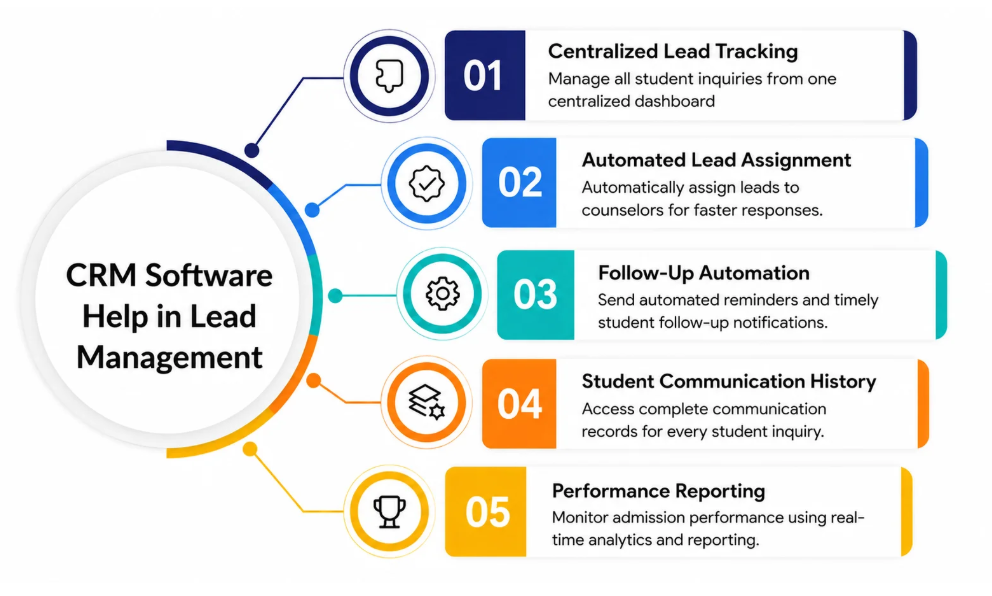
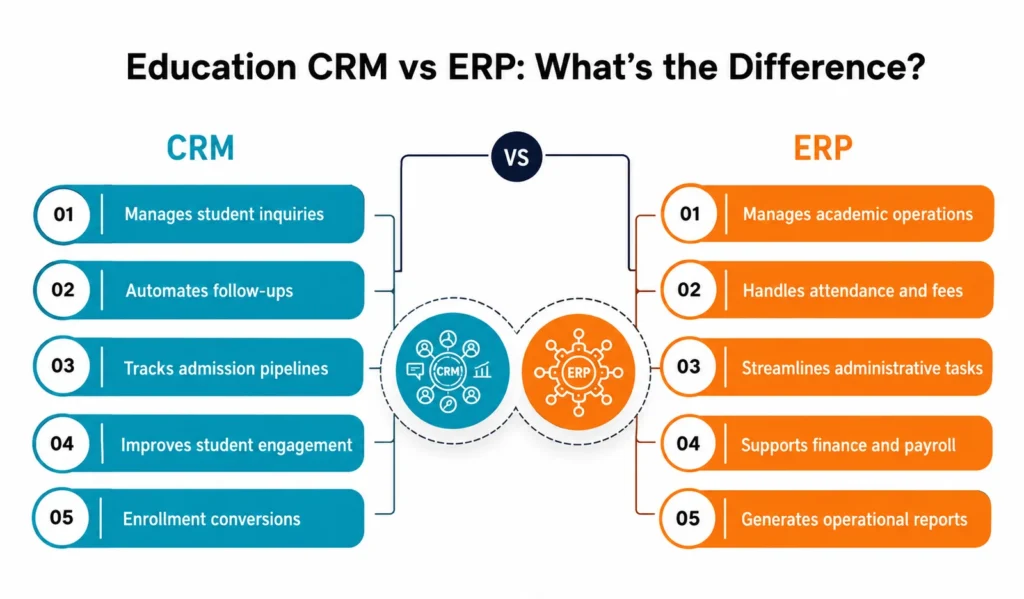
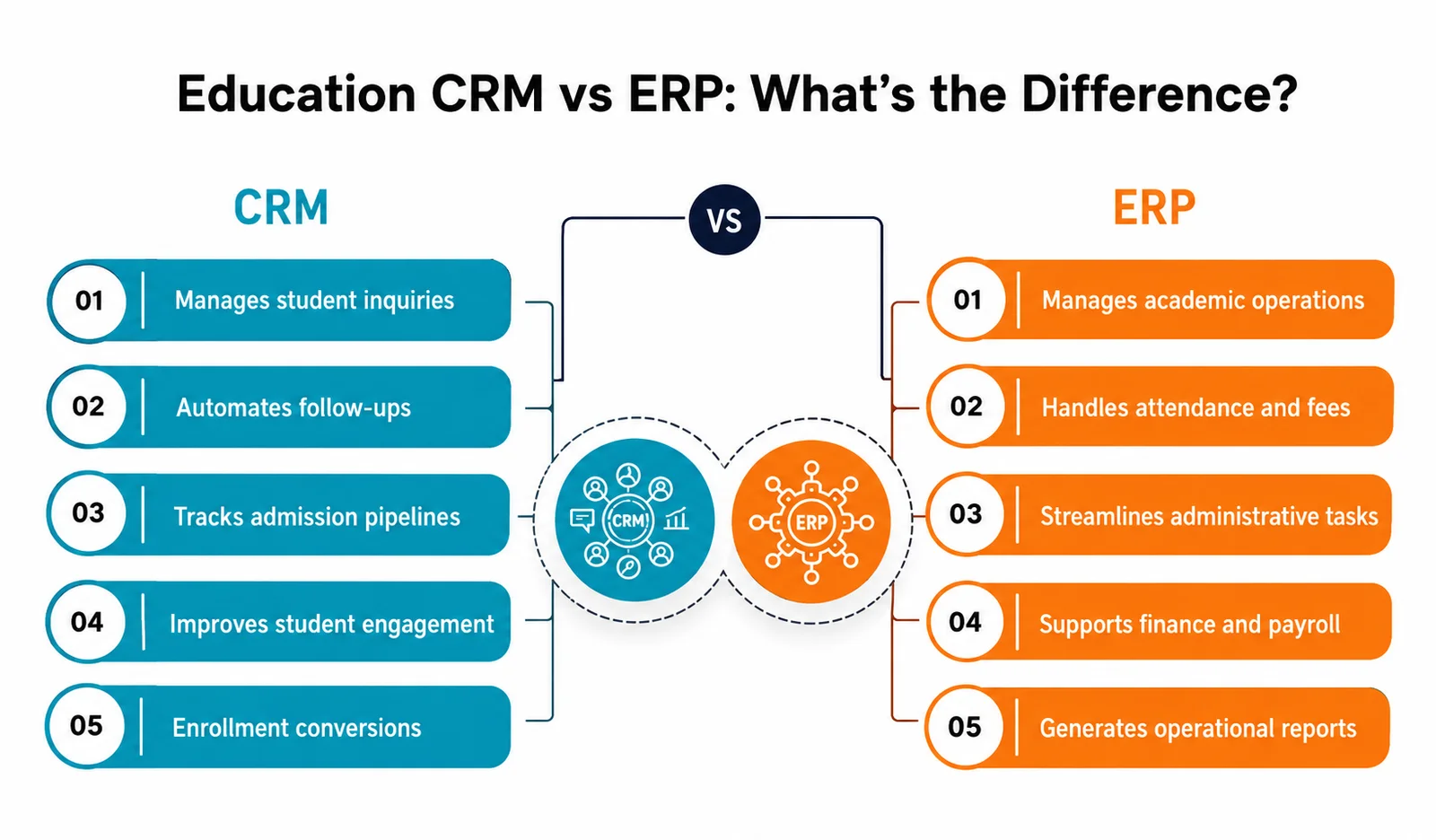
Educational institutions use CRM software to:
- Capture inquiries from multiple channels
- Automate follow-ups
- Track admission pipelines
- Manage counsellor activities
- Monitor marketing ROI
- Improve student communication
- Increase enrollment conversions
A CRM focuses on helping institutions attract, engage, nurture, and convert prospective students more effectively.
What Is an ERP System in Education?
An Enterprise Resource Planning (ERP) system focuses on managing internal institutional operations. While CRM manages prospective student relationships, ERP manages the administrative and academic processes that occur after enrollment.
Educational ERP systems typically centralize:
- Student records
- Attendance management
- Examination systems
- Fee management
- Human resources
- Payroll
- Timetable scheduling
- Academic reporting
- Library management
- Faculty administration
ERP platforms are designed to improve operational efficiency by integrating multiple internal departments into a unified system.
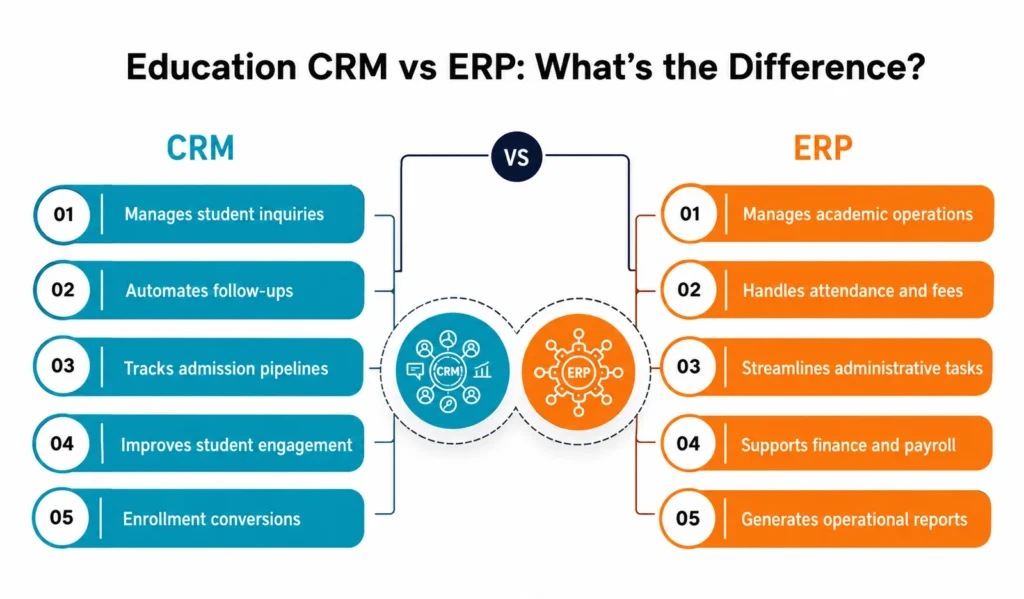
Education CRM vs ERP: Understanding the Core Difference
Although CRM and ERP systems often work together, their primary objectives are different.
| Feature | Education CRM | Education ERP |
|---|---|---|
| Primary Focus | Student acquisition and admissions | Academic and administrative management |
| User Group | Admission teams, marketing teams, counselors | Faculty, administration, finance, HR |
| Inquiry Management | Yes | Limited |
| Lead Tracking | Yes | No |
| Marketing Automation | Yes | No |
| Student Communication | Extensive | Basic |
| Academic Operations | Limited | Yes |
| Attendance Management | No | Yes |
| Examination Management | No | Yes |
| Fee Management | Limited | Yes |
| Enrollment Analytics | Yes | Limited |
| Internal Administration | No | Yes |
The simplest way to understand the difference is:
CRM helps institutions acquire students. ERP helps institutions manage students after enrollment.
Which Is Better CRM or ERP?
Another frequently searched question is:
Which Is Better CRM or ERP?
The answer depends entirely on the institution’s goals.
If your primary challenge involves generating inquiries, improving admissions, increasing enrollment conversions, and managing communication, a CRM is often the higher priority.
If your institution struggles with academic administration, student records, examinations, fee collection, and internal operations, an ERP may be more critical.
However, for most growing educational institutions, the question is not CRM versus ERP.
The real question is how both systems can work together to support the complete student lifecycle.
A CRM manages the pre-admission journey, while an ERP manages the post-admission experience.
Can ERP Replace CRM?
Many institutions assume that because ERP systems contain student information, they can eliminate the need for a CRM.
Can ERP Replace CRM?
In most cases, no.
ERP systems focus mainly on academic and operational management, whereas student acquisition, engagement and lead nurturing are better managed through an education CRM.
While some ERP platforms include basic communication features, they often lack advanced capabilities such as:
- Lead capture automation
- Admission funnel tracking
- Marketing campaign management
- Lead scoring
- Counselor activity monitoring
- Enrollment conversion reporting
- Multi-channel communication workflows
These functions are central to modern admissions management and are typically handled more effectively through dedicated CRM platforms.
Does an ERP Include a CRM?
Some ERP providers offer basic CRM functionality within their platforms. However, these modules are usually limited compared to specialized education CRM solutions.
A built-in CRM module may allow institutions to record inquiries and manage basic communication, but advanced features such as automation, marketing attribution, AI-driven lead scoring, and enrollment analytics are often missing.
As competition for student recruitment increases, many institutions choose specialized CRM platforms to gain greater visibility into admissions performance and marketing effectiveness.
What Are the Five ERP Modules?
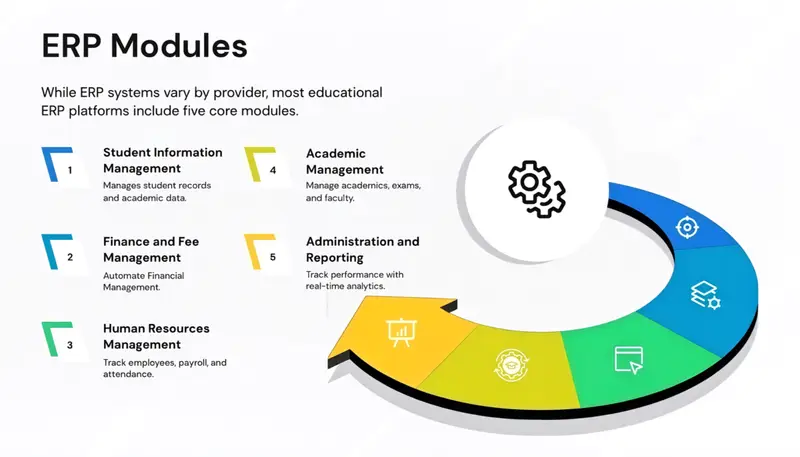
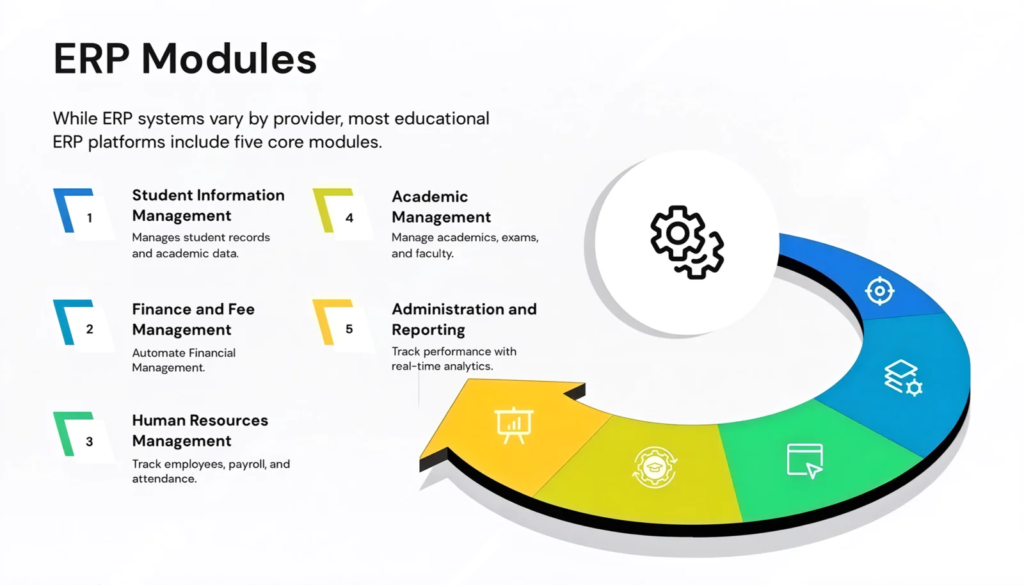
While ERP systems vary by provider, most educational ERP platforms include five core modules:
Student Information Management: This module manages student profiles, enrollment records, academic history, and institutional data.
Finance and Fee Management: Finance modules support fee collection, accounting, invoicing, budgeting, and financial reporting.
Human Resources Management: HR functionality manages employee records, recruitment, payroll, attendance, and performance tracking.
Academic Management: Academic modules support timetables, examinations, grading systems, curriculum planning, and faculty operations.
Administration and Reporting: Administrative modules provide reporting dashboards, operational analytics, compliance monitoring, and institutional performance insights.
Together, these modules create a centralized operational ecosystem for educational institutions.
Why Education CRM Is Becoming More Important in 2026
Student recruitment has become increasingly competitive across schools, colleges, universities, and education businesses. Prospective students expect personalized communication, immediate responses, and seamless digital experiences throughout the admission process.
Research consistently shows that institutions responding quickly to inquiries achieve significantly higher conversion rates than those relying on delayed manual follow-up processes.
As a result, educational institutions are investing heavily in CRM technologies that support admission automation, lead management, marketing attribution, AI-powered engagement, and student communication workflows.
The growing importance of digital-first recruitment strategies is making CRM software one of the most valuable technology investments for modern educational organizations.
How Sensation CRM Helps Educational Institutions
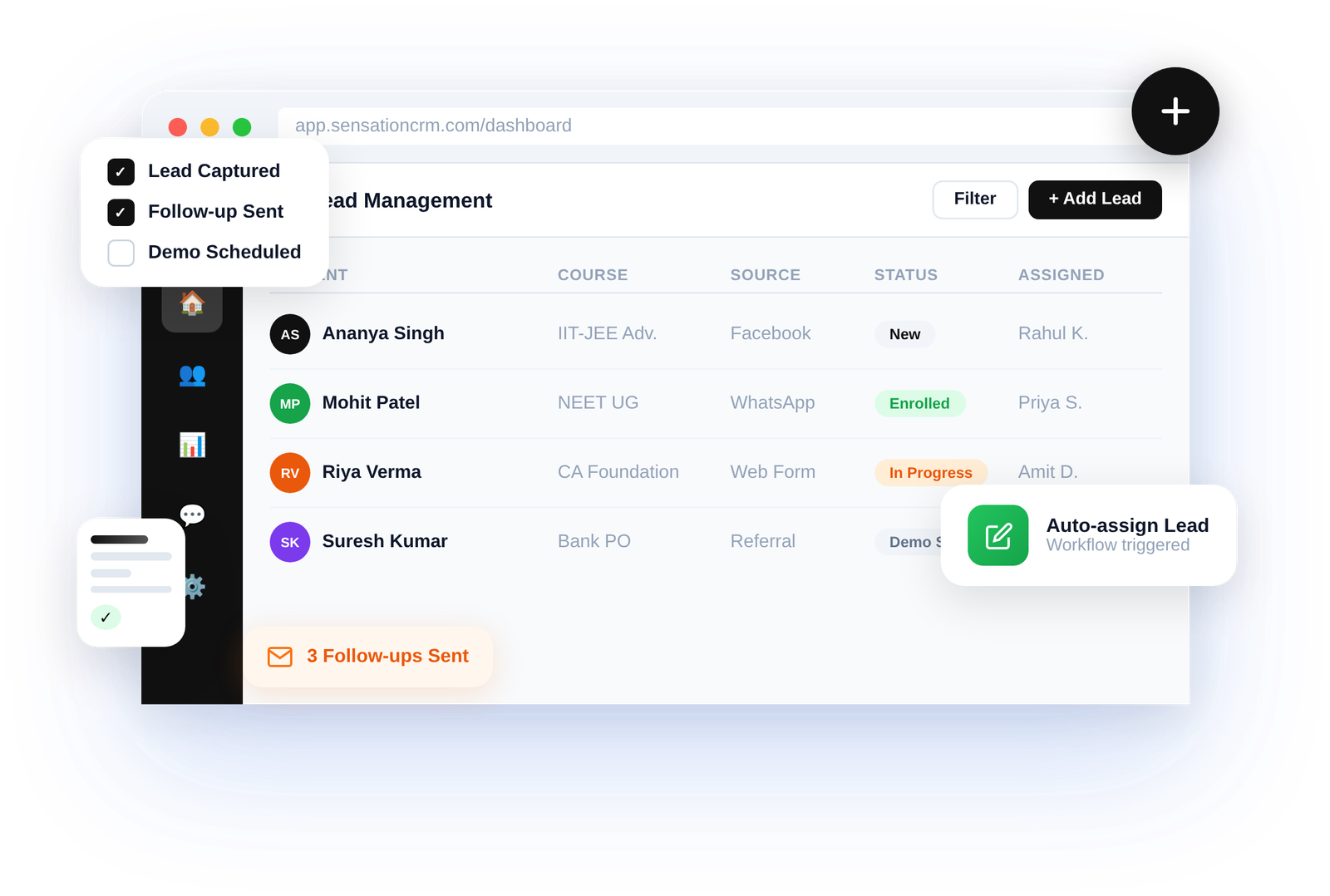
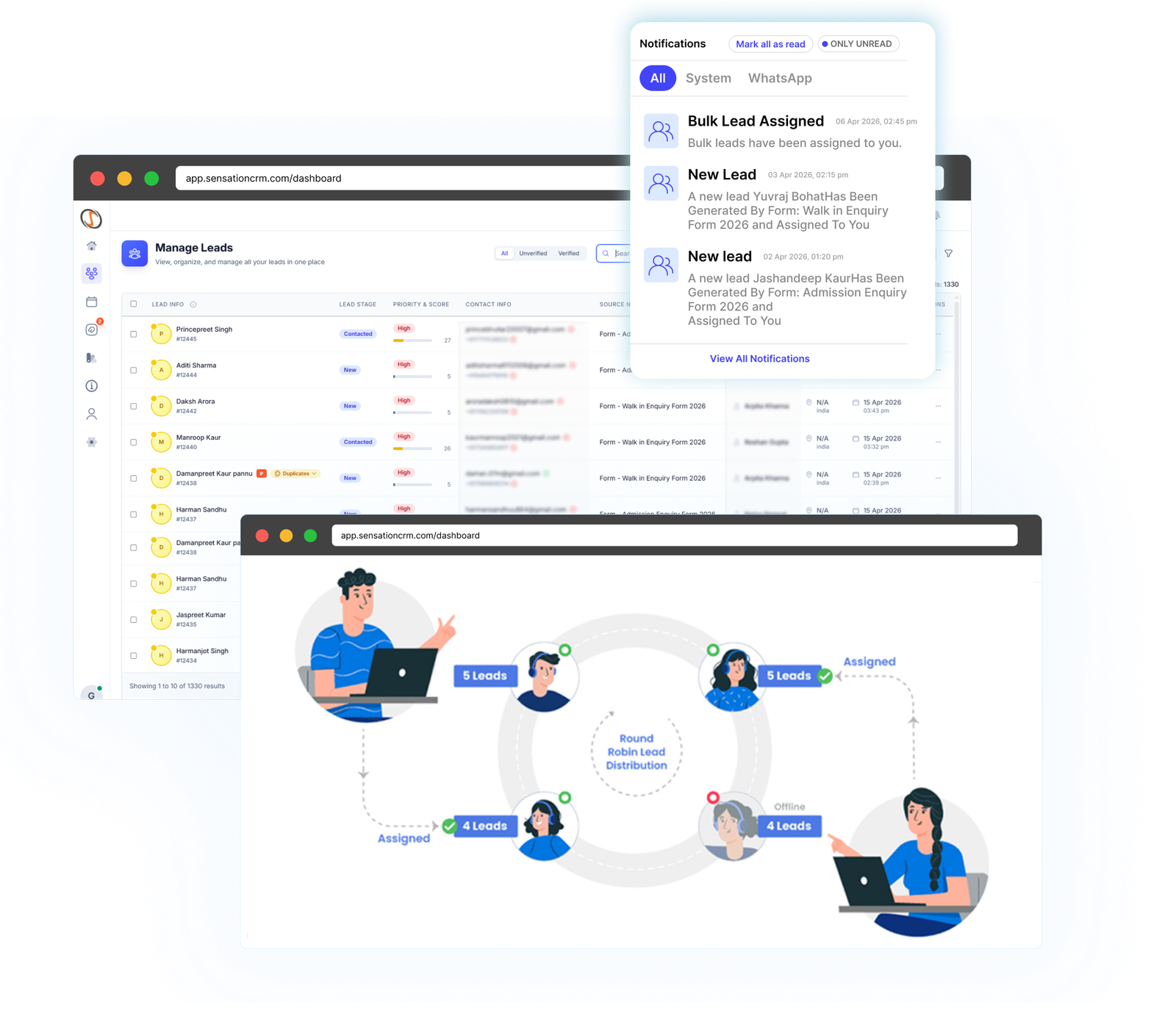
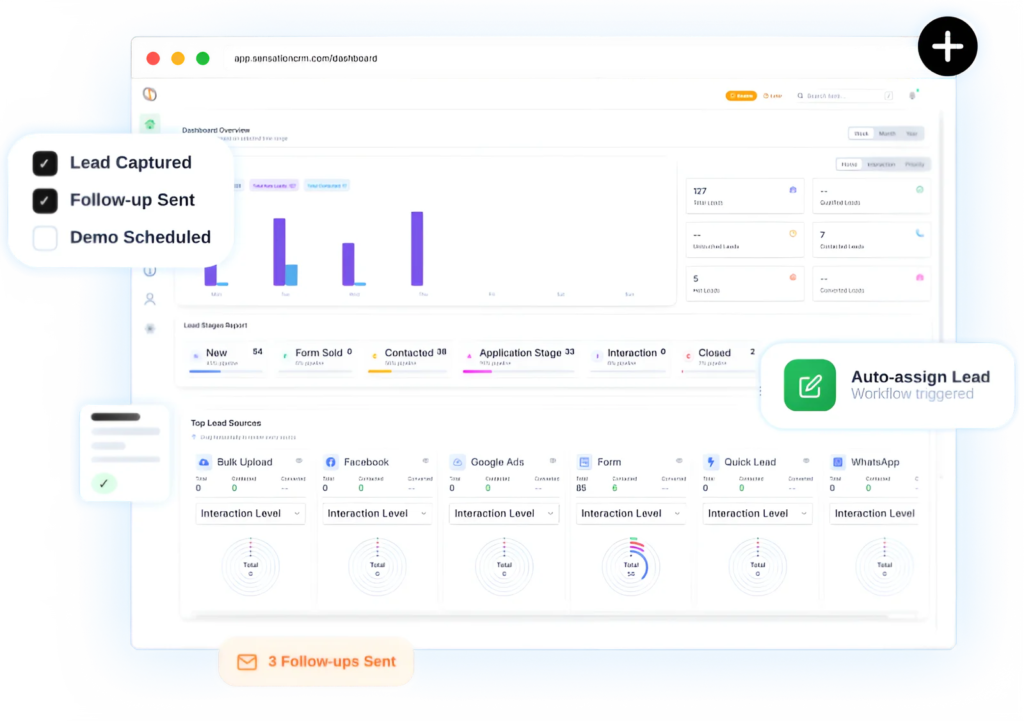
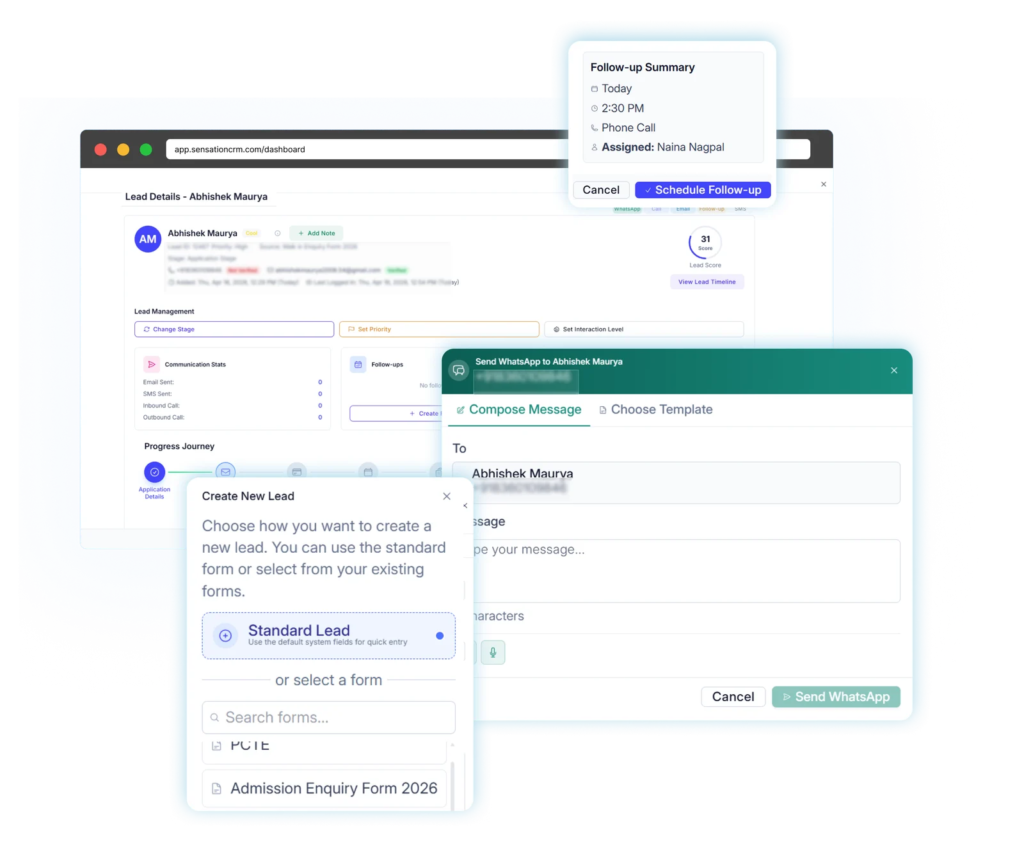
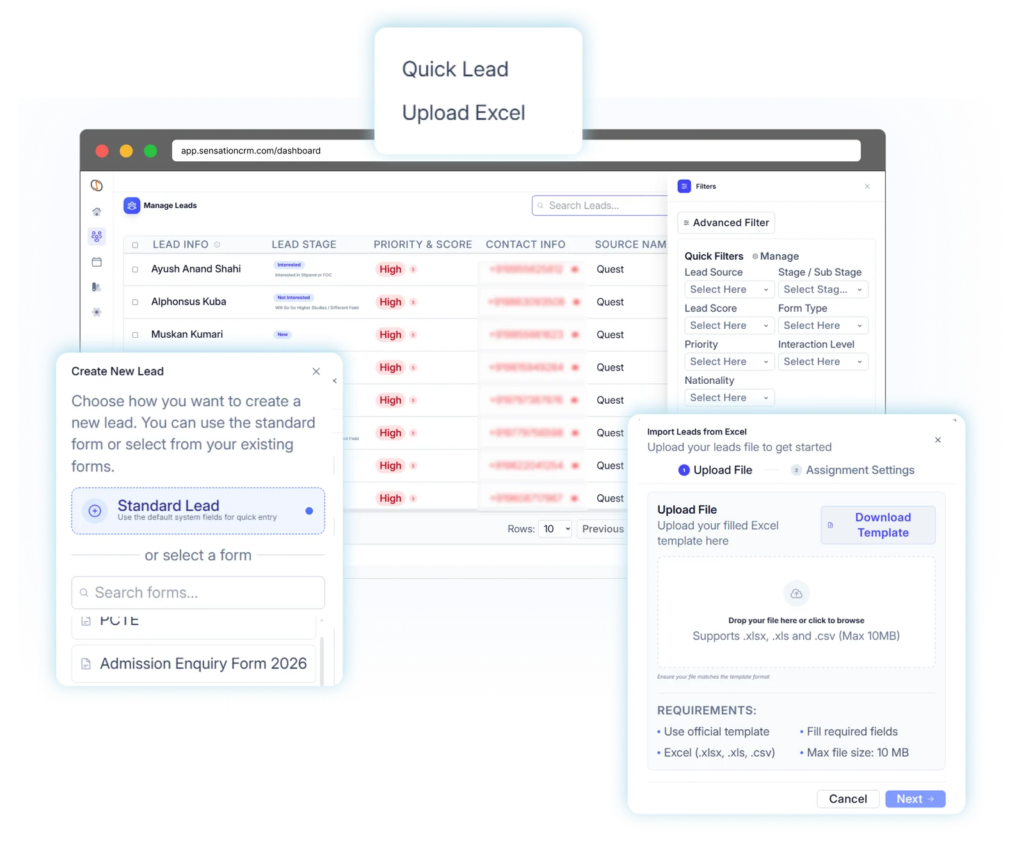
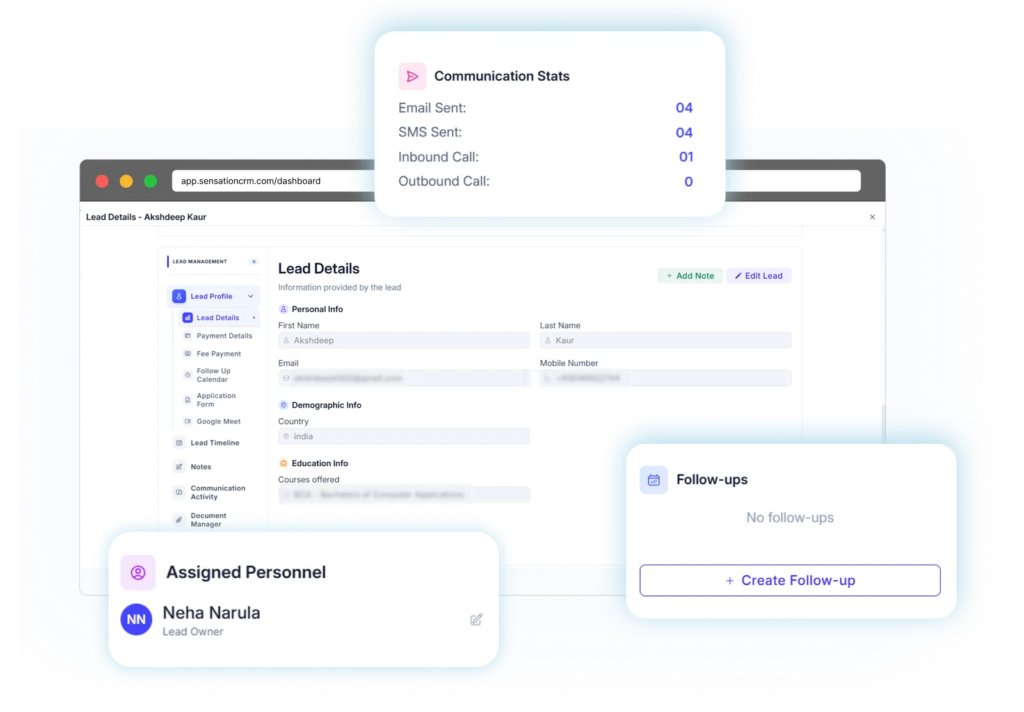
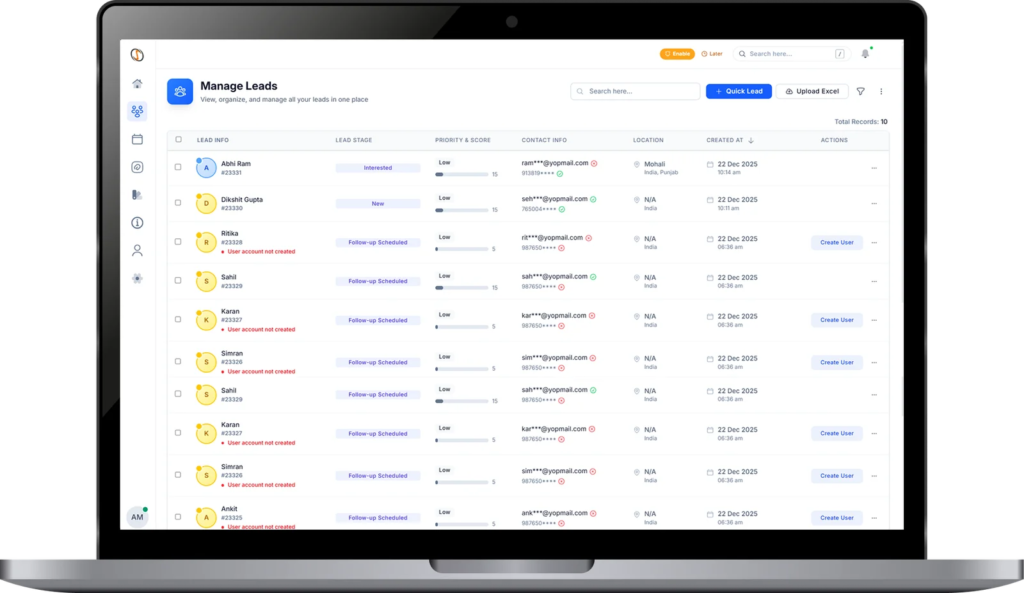
For institutions seeking a specialized solution for admissions and student engagement, Sensation CRM provides a purpose-built platform designed specifically for the education sector.
Unlike generic CRM platforms originally developed for corporate sales teams, Sensation CRM focuses on education-specific workflows and enrollment management processes.
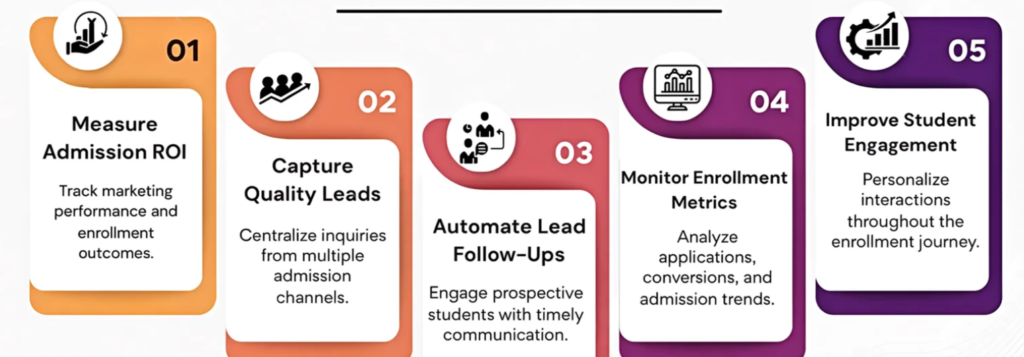
The platform helps institutions:
- Capture inquiries from multiple sources
- Automate admission follow-ups
- Manage counselor activities
- Track student communication
- Measure marketing campaign performance
- Monitor enrollment conversion rates
- Improve lead response times
- Generate admission reports and analytics
By centralizing admissions and student engagement activities, Sensation CRM enables institutions to create more efficient recruitment processes while improving student experiences.
For colleges and universities managing thousands of inquiries annually, AI-driven CRM platforms provide a measurable competitive advantage.
Education Technology Market Growth
The global education technology market continues to expand rapidly as institutions increase investments in digital transformation initiatives. Industry reports estimate that the EdTech sector will surpass hundreds of billions of dollars in market value over the next decade, driven by growing demand for online learning, student engagement technologies, automation platforms, and data-driven admissions systems.
At the same time, CRM adoption within higher education continues rising as institutions seek better ways to manage recruitment, improve enrollment outcomes, and personalize student communication at scale.
Which One to Choose – CRM or ERP?
The debate between CRM and ERP is not about choosing one over the other. Both systems address different aspects of institutional success.
An education CRM helps attract, nurture, and convert prospective students, while an ERP manages the operational and academic processes that support enrolled students. Contact us today to learn how the right solution can help your institution improve efficiency and drive sustainable growth.
For institutions focused on improving admissions, lead management, communication, and enrollment performance, CRM often delivers the fastest measurable impact. Meanwhile, ERP systems remain essential for academic administration and internal operations.
Organizations looking to improve student recruitment and admission efficiency can explore Sensation CRM, a specialized solution designed to help educational institutions streamline admissions, manage inquiries, automate communication, and improve enrollment outcomes.
Frequently Asked Questions
What is CRM for education?
An education CRM is a student relationship management platform that helps schools, colleges, universities, and education businesses manage inquiries, admissions, communication, lead nurturing, and enrollment processes.
Which is better CRM or ERP?
Can ERP replace CRM?
Does an ERP include a CRM?
What are the five ERP modules?
Why do educational institutions need CRM software?
How does Sensation CRM help colleges and universities?
Categories: Education CRM, Education CRM Software
Tags: crm for education industry, crm software india, Education CRM, Education CRM Software