Tag: Lead Management Challenges

  • garvesh&saiyam&aniket

    Why AI & ML Development Services Are Important for AI-Driven Business Innovation
    Artificial intelligence is no longer limited to research labs or large technology corporations. Businesses across healthcare, finance, ecommerce, logistics, education, manufacturing, and real estate are now integrating intelligent systems into daily operations to improve productivity, automate repetitive tasks, and create more personalized customer experiences.

    The growing demand for intelligent automation has significantly increased the importance of AI & ML development services. Organizations are no longer investing in AI only for experimentation. They now require scalable AI ecosystems capable of improving operational efficiency, accelerating decision-making, and supporting long-term digital transformation strategies.

    Operational Infrastructure Layer for Modern Businesses

    Technology leaders and global enterprises increasingly view AI as the next major operational infrastructure layer for modern businesses. Microsoft CEO Satya Nadella recently emphasized that every company will eventually become an AI-powered company as intelligent systems continue integrating into daily business operations. Similarly, Jensen Huang has repeatedly stated that AI is becoming the “new industrial revolution” because of its impact on productivity, automation, and enterprise innovation.

    According to recent enterprise AI studies, nearly 88% of organizations now use AI in at least one business function, while more than 80% of enterprises plan to increase AI investment over the next two years. This rapid adoption reflects how AI is shifting from optional technology investment toward essential business infrastructure.

    Growing Business Dependence on AI and ML Services

    Businesses today are generating enormous amounts of operational and customer data through websites, mobile apps, CRMs, IoT devices, cloud platforms, and digital interactions. Managing this information manually is becoming increasingly difficult for companies operating at scale.

    This is where ai and ml services are helping businesses automate analysis, improve forecasting, optimize workflows, and deliver faster customer experiences using intelligent algorithms and predictive systems.

    AI Is Becoming the Foundation of Modern Digital Transformation

    Digital transformation strategies are no longer limited to cloud migration, websites, or mobile applications. AI integration is now considered a central component of enterprise modernization.

    Organizations are using AI to:

    • Automate repetitive workflows

    • Improve customer personalization

    • Optimize marketing performance

    • Predict customer behavior

    • Strengthen cybersecurity systems

    • Enhance operational forecasting

    • Improve business intelligence reporting

    Research from recent market studies indicates that companies successfully implementing AI-powered automation often experience measurable gains in operational efficiency and customer engagement.

    AI Adoption Trends across Industries

    The AI market is evolving rapidly across nearly every industry sector. Businesses are increasingly prioritizing automation, predictive analytics, and intelligent customer experiences.

    Some of the fastest-growing AI adoption trends include:

    • Generative AI integration

    • AI copilots for enterprises

    • Conversational AI systems

    • AI-powered search experiences

    • Autonomous workflow automation

    • Hyper-personalization engines

    • AI-driven cybersecurity

    • Multimodal AI systems

    • Voice-enabled business platforms

    Industry analysts predict that global AI spending will continue increasing aggressively as organizations move from experimental AI pilots toward enterprise-wide deployment strategies.

    Generative AI Is Reshaping Enterprise Operations

    The rise of generative AI platforms has accelerated enterprise AI adoption significantly during the past two years. Businesses are now using AI-generated content, intelligent coding assistants, automated design systems, and AI-powered communication tools to improve productivity.

    Technology companies, start-ups, and enterprises are increasingly integrating AI copilots directly into business workflows.

    Sam Altman has publicly stated that AI systems will fundamentally reshape how businesses operate, communicate, and build products during the next decade. This shift is already visible across industries adopting AI-assisted development, automation, and customer engagement systems.

    Technology leaders and global enterprises increasingly view AI as the next major operational infrastructure layer for modern businesses. Microsoft CEO Satya Nadella recently emphasized that every company will eventually become an AI-powered company as intelligent systems continue integrating into daily business operations. Similarly, Jensen Huang has repeatedly stated that AI is becoming the “new industrial revolution” because of its impact on productivity, automation, and enterprise innovation.

    According to recent enterprise AI studies, nearly 88% of organizations now use AI in at least one business function, while more than 80% of enterprises plan to increase AI investment over the next two years. This rapid adoption reflects how AI is shifting from optional technology investment toward essential business infrastructure.

    Growing Business Dependence on AI and ML Services

    Businesses today are generating enormous amounts of operational and customer data through websites, mobile apps, CRMs, IoT devices, cloud platforms, and digital interactions. Managing this information manually is becoming increasingly difficult for companies operating at scale.

    This is where ai and ml services are helping businesses automate analysis, improve forecasting, optimize workflows, and deliver faster customer experiences using intelligent algorithms and predictive systems.

    AI Is Becoming the Foundation of Modern Digital Transformation

    Digital transformation strategies are no longer limited to cloud migration, websites, or mobile applications. AI integration is now considered a central component of enterprise modernization.

    Organizations are using AI to:

    • Automate repetitive workflows

    • Improve customer personalization

    • Optimize marketing performance

    • Predict customer behavior

    • Strengthen cybersecurity systems

    • Enhance operational forecasting

    • Improve business intelligence reporting

    Research from recent market studies indicates that companies successfully implementing AI-powered automation often experience measurable gains in operational efficiency and customer engagement.

    AI Adoption Trends across Industries

    The AI market is evolving rapidly across nearly every industry sector. Businesses are increasingly prioritizing automation, predictive analytics, and intelligent customer experiences.

    Some of the fastest-growing AI adoption trends include:

    • Generative AI integration

    • AI copilots for enterprises

    • Conversational AI systems

    • AI-powered search experiences

    • Autonomous workflow automation

    • Hyper-personalization engines

    • AI-driven cybersecurity

    • Multimodal AI systems

    • Voice-enabled business platforms

    Industry analysts predict that global AI spending will continue increasing aggressively as organizations move from experimental AI pilots toward enterprise-wide deployment strategies.

    Generative AI Is Reshaping Enterprise Operations

    The rise of generative AI platforms has accelerated enterprise AI adoption significantly during the past two years. Businesses are now using AI-generated content, intelligent coding assistants, automated design systems, and AI-powered communication tools to improve productivity.

    Technology companies, start-ups, and enterprises are increasingly integrating AI copilots directly into business workflows.

    Sam Altman has publicly stated that AI systems will fundamentally reshape how businesses operate, communicate, and build products during the next decade. This shift is already visible across industries adopting AI-assisted development, automation, and customer engagement systems.

    What Is AI and ML Development?
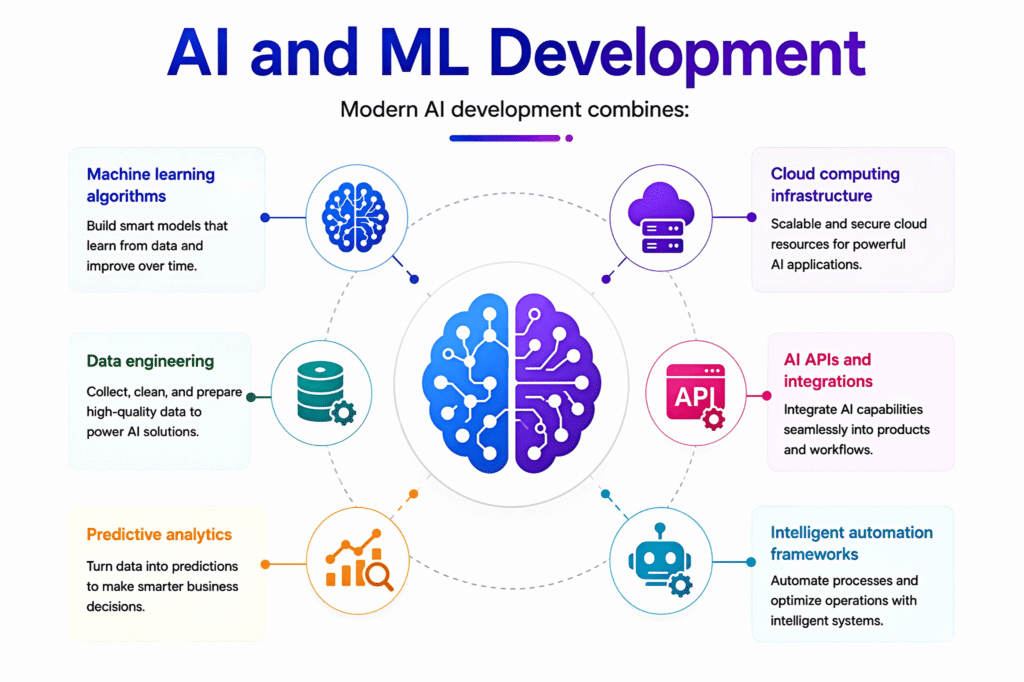
    AI and ML development involves creating intelligent software systems capable of learning from data, identifying patterns, automating decisions, and improving performance over time.

    Artificial Intelligence (AI) focuses on simulating human intelligence using technologies such as natural language processing, reasoning systems, conversational AI, and computer vision. Machine Learning (ML), which is a subset of AI, enables systems to learn from historical data automatically without requiring explicit programming for every task.

    Modern AI development combines:

    • Machine learning algorithms

    • Cloud computing infrastructure

    • Data engineering

    • AI APIs and integrations

    • Predictive analytics

    • Intelligent automation frameworks

    Businesses increasingly partner with an experienced AI & ML development company to build scalable AI systems tailored to operational goals and customer requirements.

    What Are the 4 Types of AI?

    AI technologies are generally categorized into four major types based on capability and intelligence levels.

    Reactive Machines: Reactive AI systems respond to specific inputs without storing memories or learning from past interactions. Basic recommendation engines and rule-based automation systems often fall into this category.

    Limited Memory AI: Limited memory AI systems learn from historical data to improve future predictions and decisions. Most modern AI-powered business applications operate within this category.

    Examples include:

    • Predictive analytics

    • Autonomous systems

    • AI recommendation engines

    • Conversational AI platforms

    Theory of Mind AI: Theory of Mind AI focuses on understanding emotions, intentions, and human behavior. Although still in research stages, this area may influence future customer engagement systems and robotics technologies.

    Self-Aware AI: Self-aware AI represents hypothetical systems capable of consciousness and self-awareness. While widely discussed in AI theory, this level of AI has not yet been achieved.

    What Are AI ML Services?

    AI ML services include the design, development, deployment, and maintenance of intelligent software systems that automate workflows and improve business decision-making.

    Modern AI and ML services commonly include:

    • • Custom AI software development
    • • Machine learning model development
    • • AI chatbot solutions
    • • Predictive analytics systems
    • • Natural language processing applications
    • • Computer vision solutions
    • • AI automation systems
    • • Recommendation engine development
    • • AI cloud integration
    • • Enterprise AI consulting

    Businesses increasingly work with a custom ai development company to build industry-specific AI platforms rather than relying only on generic automation tools.

    What’s the Main Difference Between AI and ML?

    Artificial Intelligence is the broader concept focused on creating machines capable of performing tasks that normally require human intelligence. Machine Learning is a specialized branch of AI focused specifically on systems learning from data automatically.

    In simple terms:

    • AI focuses on intelligent behavior

    • ML focuses on learning from data patterns

    For example, AI powers conversational assistants, while machine learning improves those assistants by analyzing user interactions and behavioral trends.

    What Does an AI ML Developer Do?

    An AI ML developer builds, trains, tests, and deploys intelligent systems capable of automating business operations and processing large datasets efficiently.

    Their responsibilities often include:

    • Developing machine learning algorithms

    • Training predictive models

    • Optimizing AI systems

    • Managing AI infrastructure

    • Integrating AI APIs

    • Building intelligent automation workflows

    • Improving model accuracy and scalability

    As AI adoption continues expanding, AI ML developers are becoming critical contributors to enterprise innovation, operational modernization, and AI trends shaping web development 2026.

    AI Features Businesses Now Demand Across All Industries
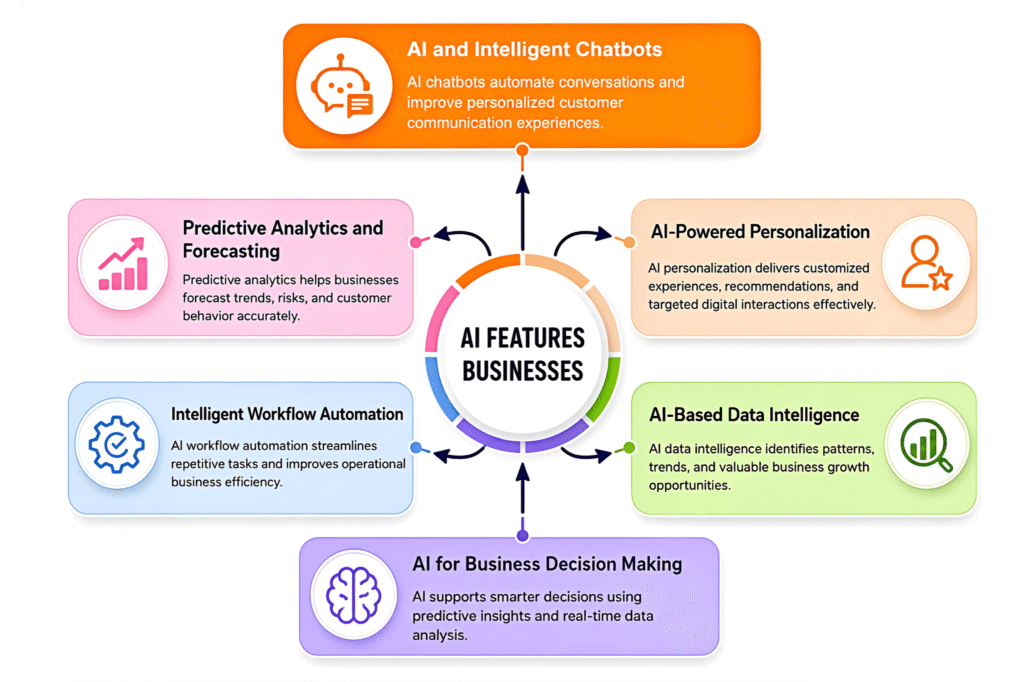
    Businesses are increasingly searching for advanced AI capabilities that improve automation, personalization, operational efficiency, and customer engagement.

    Conversational AI and Intelligent Chatbots

    AI-powered chatbots have evolved far beyond scripted customer support systems. Modern conversational AI platforms understand user intent, analyze context, and deliver personalized interactions across websites, mobile apps, and messaging platforms.

    Businesses now use conversational AI for:

    • Customer support automation

    • Lead qualification

    • Appointment scheduling

    • Ecommerce assistance

    • Internal employee support

    • Healthcare communication

    Recent industry reports indicate that AI-powered customer service systems can reduce support response times significantly while improving customer satisfaction levels.

    Predictive Analytics and Forecasting

    Predictive analytics has become one of the most valuable enterprise AI applications. Businesses use predictive systems to forecast customer behavior, operational risks, inventory demand, and sales trends.

    Industries actively using predictive analytics include:

    • Ecommerce

    • Healthcare

    • Finance

    • Logistics

    • Retail

    • Manufacturing

    Organizations implementing predictive analytics often improve operational planning and business forecasting accuracy substantially.

    AI-Powered Personalization

    Consumers increasingly expect personalized digital experiences. AI systems help businesses deliver tailored product recommendations, content suggestions, targeted marketing campaigns, and customized communication strategies.

    AI-driven personalization is now widely used across:

    • Streaming platforms

    • Ecommerce systems

    • EdTech applications

    • Healthcare platforms

    • Financial services

    • Travel technology

    Market research suggests that businesses using AI personalization strategies often experience stronger customer engagement and higher conversion performance.

    Intelligent Workflow Automation

    AI-powered workflow automation is helping organizations reduce repetitive operational tasks while improving speed and consistency.

    Popular AI workflow automation use cases include:

    • Invoice processing

    • CRM automation

    • HR onboarding

    • Customer support ticket routing

    • Compliance monitoring

    • Document verification

    Many enterprises are now redesigning operational structures around AI-driven automation rather than treating AI as an additional support layer.

    AI-Based Data Intelligence

    Organizations generate massive amounts of customer and operational data daily. AI-powered analytics systems help identify trends, anomalies, behavioral patterns, and business opportunities much faster than traditional reporting methods.

    AI-based business intelligence improves:

    • Strategic planning

    • Customer targeting

    • Revenue forecasting

    • Operational visibility

    • Market analysis

    • Performance optimization

    Why Businesses Prefer Custom AI Development Companies

    Many organizations prefer working with a custom AI development company instead of relying only on prebuilt AI software products.

    Industry-Specific AI Solutions

    Different industries require different operational workflows. A healthcare provider needs different AI capabilities compared to a logistics company or ecommerce platform.

    Custom AI development allows businesses to create tailored systems aligned with operational goals and industry-specific challenges.

    Better Scalability and Integration

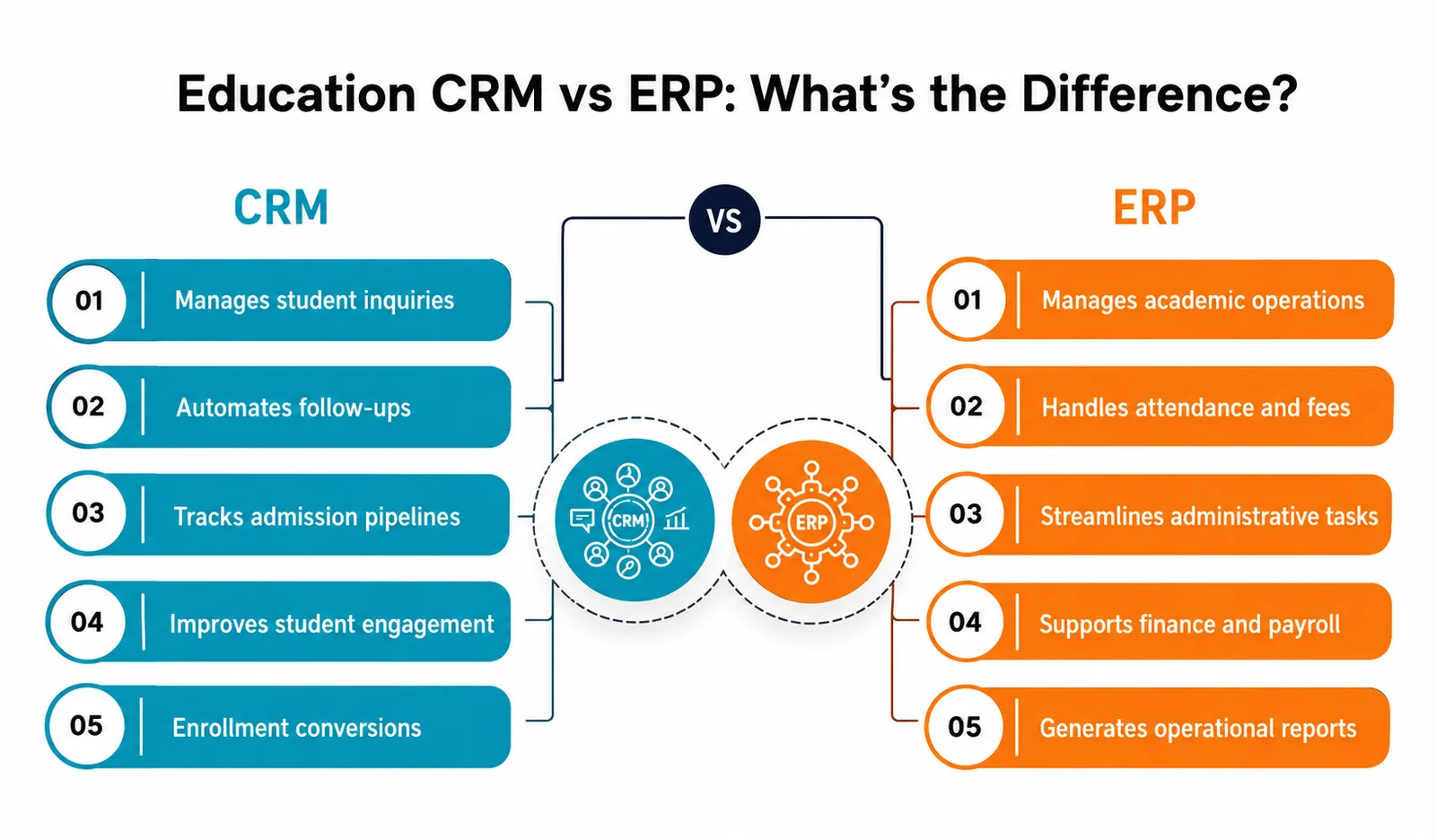
    Custom AI systems integrate more effectively with existing business infrastructure including CRMs, ERPs, cloud environments, mobile applications, and enterprise platforms.

    This supports stronger long-term scalability and operational consistency.

    Greater Data Security and Control

    Businesses handling sensitive customer or operational data often prefer custom AI environments because they provide stronger compliance control, infrastructure flexibility, and data governance capabilities. Sensation Software Solutions helps enterprises build secure AI systems for healthcare, finance, insurance, and enterprise environments.

    Comparison Between Traditional Software and AI-Powered Business Systems

    FeatureTraditional Software SystemsAI-Powered Business Systems
    Automation CapabilityRule-based automationIntelligent adaptive automation
    Data ProcessingManual analysis dependentReal-time predictive analysis
    Customer PersonalizationLimitedAdvanced AI-driven personalization
    Workflow OptimizationStatic workflowsSelf-improving operational systems
    Decision SupportBasic reportingPredictive recommendations
    ScalabilityLimited flexibilityHighly scalable intelligent systems
    User ExperienceStandard interactionsContext-aware experiences
    Operational EfficiencyModerateHigh automation efficiency

    Businesses implementing AI-driven systems are increasingly achieving stronger scalability, faster decision-making, and improved customer engagement compared to traditional software environments.

    Future of AI and ML Development Services

    AI adoption is expected to continue accelerating as businesses increasingly invest in intelligent automation, predictive intelligence, and enterprise AI infrastructure.

    Some major trends shaping the future of AI include:

    • AI copilots for enterprises

    • Autonomous workflow systems

    • Generative AI integration

    • AI-driven cybersecurity

    • Hyper-personalized digital experiences

    • Voice-enabled enterprise platforms

    • Multimodal AI systems

    • AI-powered search ecosystems

    Industry forecasts suggest that AI-powered operations will continue transforming healthcare, finance, retail, manufacturing, logistics, education, and enterprise software ecosystems over the next decade. Contact us today to explore future-ready AI solutions for your business growth.

    Organizations exploring enterprise-grade artificial intelligence solutions can also learn more about advanced AI & Machine Learning Development Services designed to support intelligent automation, predictive analytics, and scalable AI-powered business innovation.
  • Lead Management _ Lakshay Kamboj

    Lead Management _ Lakshay Kamboj

    Home » Lead Management Challenges

    Why Lead Management Matters for Educational Institutions

    Institutions today receive student inquiries from multiple channels such as websites, social media, education fairs, walk-ins, digital agencies, and paid campaigns. Without a centralized student lead management system, these leads often result in leakage, duplication, and missed follow-ups.

    lead management process

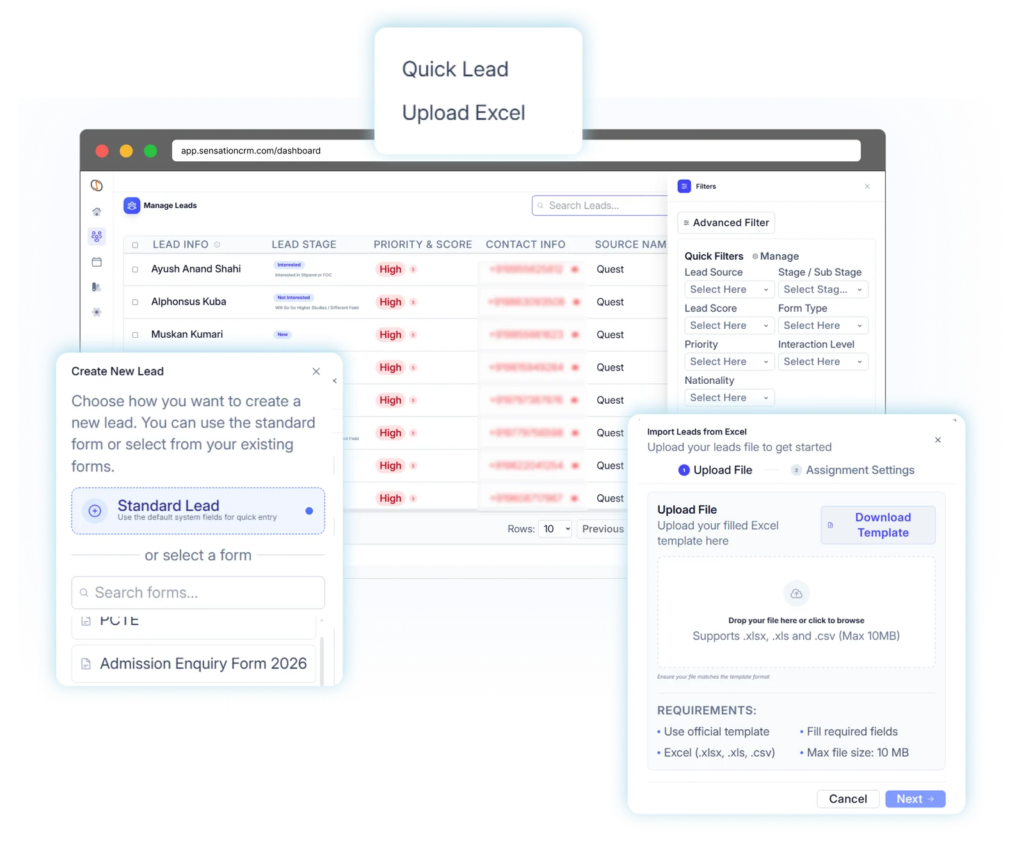
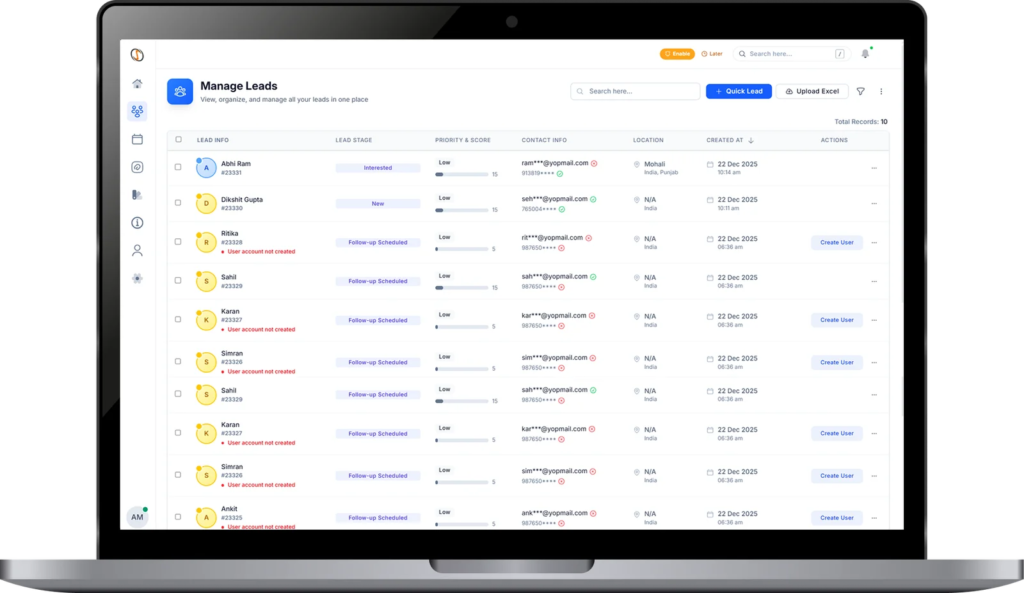
    Sensation CRM addresses this challenge by consolidating all leads into a single platform for any online learning platform in India providing complete visibility and control, improving team accountability, and enabling faster, more coordinated action across departments.

    Centralize All Your Leads From Every Source

    lead tracking system for education india
    Bring Every Inquiry into One Powerful Dashboard:

    Advanced tracking icon

    Website & Landing Pages: Capture instantly via smart embed forms

    In-depth monitoring icon

    Social Media (Lead Management)& Campaigns: Auto-import from Facebook, Google Ads, Instagram

    Advanced tracking icon

    Walk-ins & Offline Events: Bulk upload from seminars, fairs, and promotions

    In-depth monitoring icon

    Phone & WhatsApp lead management Inquiries: Sync incoming leads automatically

    In-depth monitoring icon

    Education Chatbot: Convert site visitors to qualified lead management 24/7

    Eliminate Lead Management Duplication & Leakage

    Duplicate inquiries make it hard to track performance and inflate manual workload. Sensation CRM uses
    advanced source tracking and unique lead identification logic that:

    Safe & Organized icon

    Detects duplicates across channels

    Advanced Analytics icon

    Shows unified lead management history across touch pointser

    Powerful Automation icon

    Prevents re-entry of the same inquiry

    Easy And Intuitive icon

    Improves data accuracy for reporting and action

    Your counselors always know which lead to work on and who owns it.

    Smart Lead Management Distribution Right Leads to Right Counsellors

    student lead management crm india

    Capturing leads isn’t enough. You need intelligent distribution so your team responds fast and contextually, supported by a structured student management system that ensures the right counsellors get the right leads with proper access and accountability.

    This prevents bottlenecks and ensures follow-ups are fast, relevant, and precise.

    Responsive icon

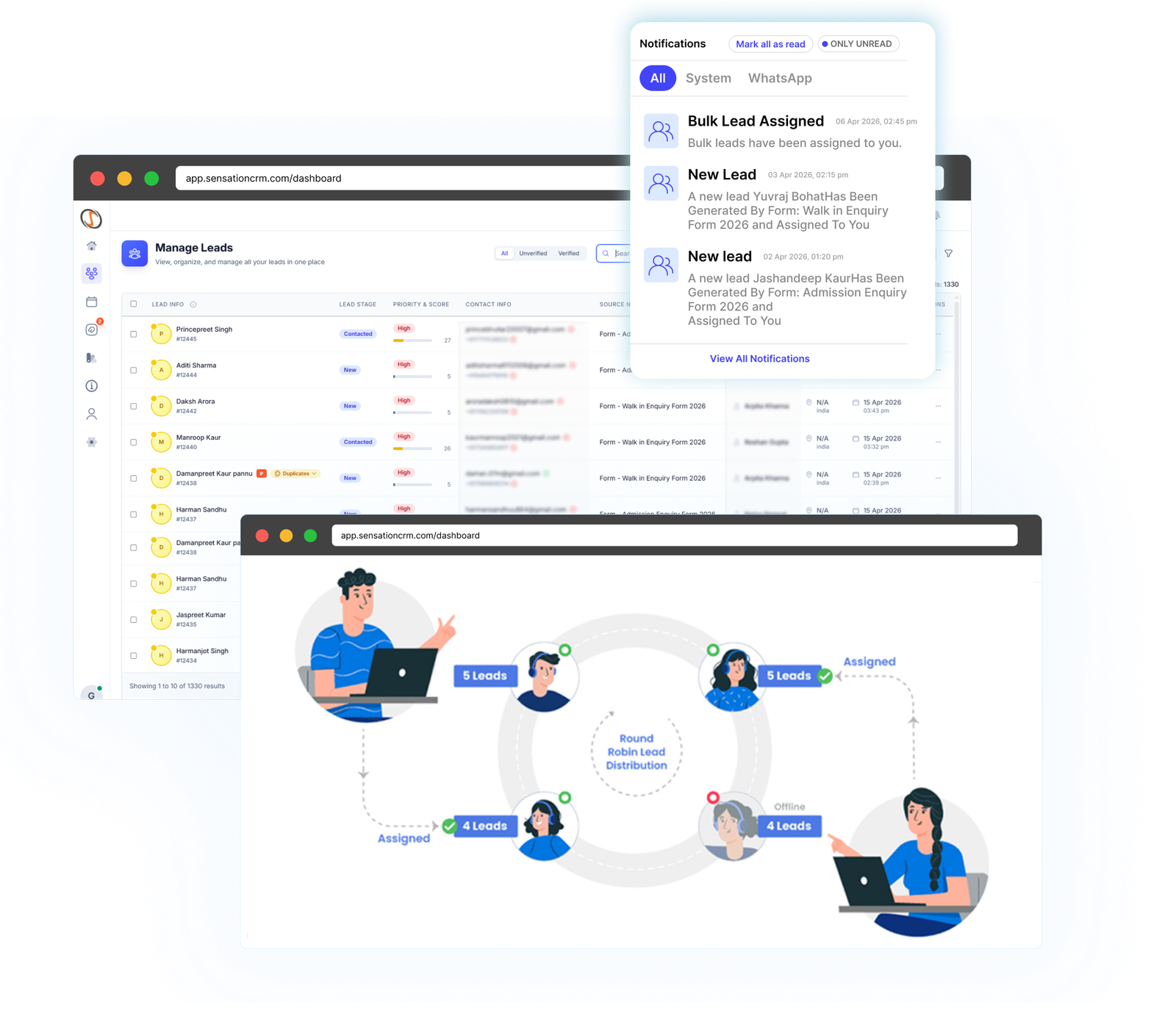
    Round-Robin Allocation
    Balanced workload across your team.

    drip campaign automation icon

    Custom Logic Rules
    Assign by course, location, score, or campaign.

    Team collaboration icon

    Automated Distribution
    No manual steps after
    setup.

    Notification icon

    Real-time Notifications
    Counselors get alerts immediately.

    Focus on High-Value Leads Management with Quality Scoring

    Not all inquiries are equal. Sensation CRM prioritizes leads so your team spends time where it matters:

    This helps you nurture and convert leads with effective lead nurturing strategies, increasing admission success rates while reducing wasted effort.

    lead management analysis
    Lead Score & Strength

    advanced tracking icon

    Track interest based on activity of lead management (form completed, site visits, interactions).

    drip campaign automation icon

    Score lead management automatically based on behaviour and engagement.

    score and reporting overview

    Identify high-intent prospects instantly.

    Lead Management On-The-Go

    Your team doesn’t only work from the office. With Sensation CRM’s mobile-ready interface, counselors can:

    lead management data

    Perfect for field teams, events, and admissions drives across locations.

    mobile monitoring icon

    Add quick leads via mobile

    Search icon

    Scan QR codes at events

    Social media automation icon

    Follow up on the move

    permission template icon

    Update lead status instantly

    Advanced Filters & Dynamic Nurturing

    Once leads are in the system, quick retrieval and action matter:

    lead management software

    Your team spends less time searching and more time engaging meaningfully.

    filter lead tracking icon

    Multi-level filters
    Search by source, status, recently contacted, engagement level

    Search icon

    Saved filters
    Reuse your most common searches

    drip campaign automation icon

    Nurturing automation
    Drip sequences based on actions or inactivity

    Real-Time Insights & Activity Tracking

    Admission success depends on timely action. Sensation CRM gives you:

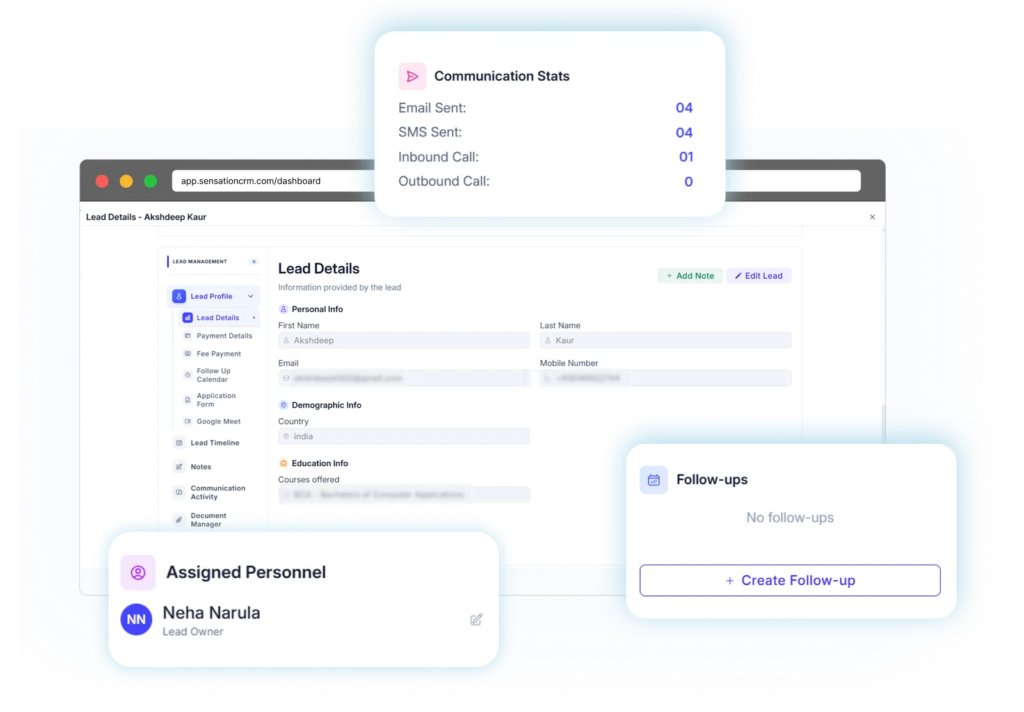
    lead details

    This translates into better decisions, faster enrollments, and reduced workload.

    mobile monitoring icon

    Unified lead timeline with all communication history

    Student activity tracking icon

    Counsellor activity logs

    customer satisfaction icon

    Engagement rates

    permission template icon

    Source performance, conversion trends

    Designed for Education Not Generic Sales Crm

    Unlike generic CRMs, Sensation CRM is a powerful Education CRM and education lead tracking system that understands the complete education ecosystem from inquiries to enrollments:

    Built as a dedicated CRM for Higher Education, it is designed for coaching institutes in India , colleges, universities, and education consultants in India seeking zero lead leakage, complete visibility, and higher conversion rates.

    filter lead tracking icon

    Centralized lead capture from online & offline

    Search icon

    Quality lead verification

    drip campaign automation icon

    Smart distribution & priority routing

    mobile monitoring icon

    Mobile-friendly action points

    permission template icon

    Real-time dashboards for exec teams

    reel icon

    Lead scoring & behavioral insights

    manage lead

    Who Can Benefit from Sensation CRM?

    Safe & Organized icon

    Coaching Institutes

    Advanced Analytics icon

    Coaching Institutes

    Powerful Automation icon

    Colleges & Universities

    Easy And Intuitive icon

    Education Consultants

    Easy And Intuitive icon

    Online EdTech Platforms

    Any organization handling student inquiries can significantly improve conversions with Sensation CRM

    Frequently Asked Questions

    What is The Stories Book about?

    This exquisite compilation showcases a diverse array of photographs that capture the essence of different eras and cultures, reflecting the unique styles and perspectives of each artist.

    How much does The Stories Book cost?

    This exquisite compilation showcases a diverse array of photographs that capture the essence of different eras and cultures, reflecting the unique styles and perspectives of each artist.

    When will The Stories Book be released?

    This exquisite compilation showcases a diverse array of photographs that capture the essence of different eras and cultures, reflecting the unique styles and perspectives of each artist.

    Are signed copies available?

    This exquisite compilation showcases a diverse array of photographs that capture the essence of different eras and cultures, reflecting the unique styles and perspectives of each artist.

    How AI- powered Sensation CRM’s help in Lead Management System?

    Sensation CRM uses AI to automatically score, segment, and prioritize leads based on behavior, source, and engagement. This helps counselors focus on high-intent prospects, improving conversion rates and reducing manual effort.

  • Lead Management_Bhumika

    Lead Management Challenges

    Lead Management Challenges Faced by Education Consultants (And How CRM Solves Them)

    The Lead Management Challenges education sector in India is becoming more competitive every year. Schools, universities, coaching institutes, and education consultants receive inquiries from multiple channels such as websites, social media, WhatsApp, and education portals. Managing these leads efficiently has become a major challenge.

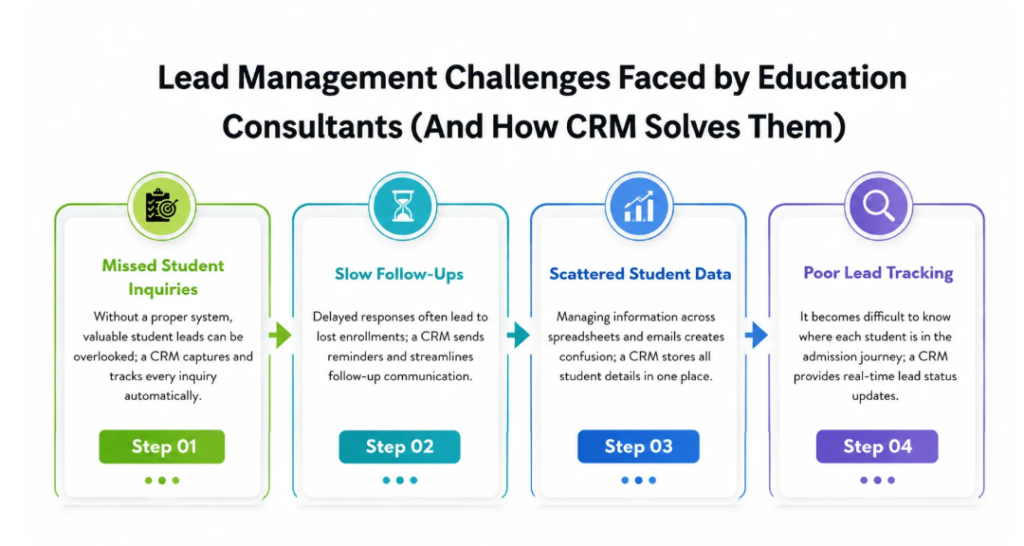
    As inquiry volumes continue increasing, managing student communication manually is becoming difficult for many organizations. Delayed follow-ups, scattered data, missed counseling calls, duplicate inquiries, and inconsistent communication often reduce enrollment conversions and operational efficiency.

    This growing complexity has increased the demand for structured Lead Management CRM systems and intelligent lead management software across the Indian education sector. Many institutions now use CRM platforms to manage inquiries from one place. These systems help counselors respond faster, automate routine tasks, and improve the admission process.

    According to recent education technology trends in India, institutions implementing CRM-driven lead management processes often improve inquiry response speed and admission conversion rates because students increasingly expect fast, personalized, and digitally connected communication experiences.

    Why Lead Management Has Become a Major Challenge for Education Consultants

    Education consulting businesses operate in a communication-heavy environment where every inquiry represents a potential admission opportunity. During peak admission seasons, consultants often manage thousands of leads simultaneously across multiple channels.

    Most organizations generate leads through:

    • Google Ads campaigns
    • Social media marketing
    • Organic website traffic
    • WhatsApp inquiries
    • Referral programs
    • Education portals
    • Seminars and webinars
    • Offline counseling events

    Without a centralized lead management crm, tracking student interactions and follow-ups becomes extremely difficult.

    Many organizations still depend on spreadsheets or disconnected tools that cannot support modern admission workflows efficiently. This often creates communication gaps, operational confusion, and reduced conversion visibility.

    What Are Common Lead Management Challenges?

    One of the most common questions education businesses ask is: “What are common lead management challenges?

    Educational consultants across India frequently struggle with operational inefficiencies while managing large inquiry pipelines.

    Delayed Lead Response Time

    Imagine a student submitting inquiries to three overseas education consultants. If one consultant responds within five minutes while another takes two days, the student is far more likely to continue the conversation with the faster responder.

    Scattered Student Data

    Many organizations manage student information across spreadsheets, emails, WhatsApp chats, and separate communication platforms. This creates fragmented records and makes it difficult for counselors to track student history, previous interactions, and application progress accurately.

    Poor Follow-Up Management

    Consistent follow-up remains one of the biggest challenges in lead generation in India for education businesses. Counselors handling large inquiry volumes often miss reminders, callbacks, or long-term nurturing opportunities. Without automation systems, valuable inquiries frequently become inactive due to communication delays.

    Duplicate Leads and Data Errors

    Educational organizations generating inquiries from multiple platforms often face duplicate entries and inconsistent data collection. This affects reporting quality, counselor coordination, and operational decision-making.

    Lack of Reporting Visibility

    Management teams often struggle to monitor:

    • Counselor productivity
    • Conversion rates
    • Lead source performance
    • Follow-up quality
    • Marketing ROI

    Without structured reporting dashboards, optimizing admission strategies becomes difficult.

    What Is the Difference Between Lead Management and CRM?

    Another common question businesses ask is: “What is the difference between lead management and CRM?”

    Lead management specifically focuses on capturing, organizing, tracking, nurturing, and converting inquiries into enrollments or customers. CRM, or Customer Relationship Management, is a broader operational framework designed to manage complete customer interactions, communication workflows, reporting systems, automation processes, and long-term engagement.

    In simple terms:

    • Lead management handles inquiry tracking and conversion workflows
    • CRM manages broader relationship and operational processes

    A modern lead management crm combines both functionalities by supporting inquiry management while also maintaining long-term communication and student engagement history.

    For educational organizations, CRM systems often become centralized platforms connecting admissions, counseling, communication, marketing, reporting, and workflow automation.
    Why Education Consultants in India Are Adopting Lead Management CRM Systems

    Educational organizations across India are increasingly investing in lead management software because student expectations and competition levels continue growing rapidly.

    Students today expect:

    • Instant responses
    • Personalized counseling
    • Real-time communication
    • Fast document coordination
    • Multi-channel engagement

    Managing these expectations manually becomes difficult as inquiry volumes increase.

    Modern lead management software india solutions help organizations automate repetitive tasks while improving communication consistency and operational efficiency. This allows counselors to focus more on student guidance and enrollment support rather than manual administrative coordination.
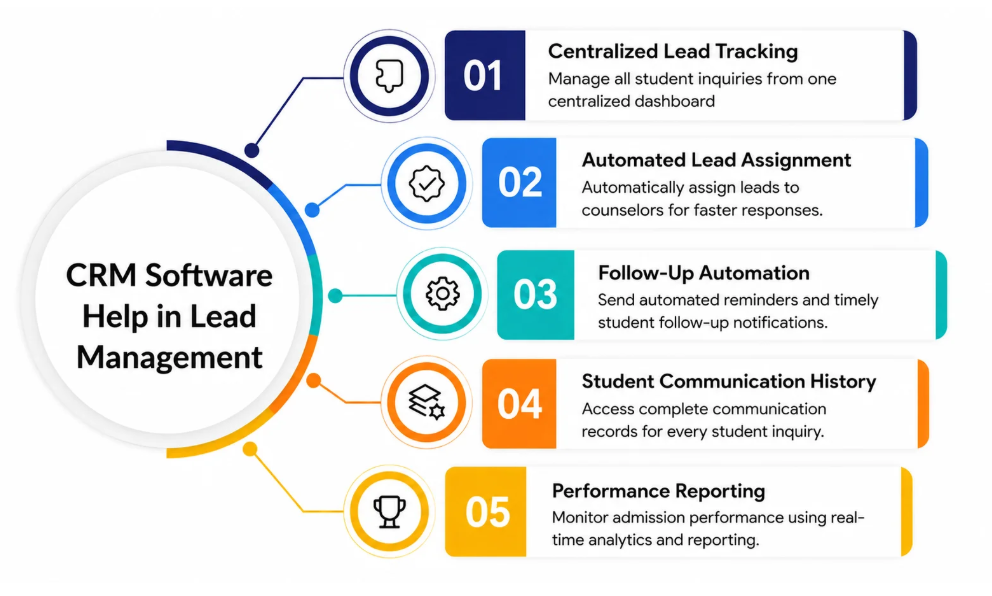
    How Does CRM Software Help in Lead Management?

    CRM Software Help in Lead Management

    One of the most important operational questions businesses ask is: “How does CRM software help in lead management?”

    Modern CRM systems streamline the complete inquiry lifecycle from lead generation to final enrollment.

    Centralized Lead Tracking

    CRM platforms collect inquiries from websites, social media campaigns, advertisements, WhatsApp, webinars, and offline campaigns into one centralized dashboard.

    This improves visibility and reduces communication gaps across teams.

    Automated Lead Assignment

    Lead management software automatically assigns inquiries to counselors based on:

    • Course interest
    • Branch preference
    • Location
    • Availability
    • Inquiry priority

    This improves response speed and operational coordination.

    Follow-Up Automation

    Automated reminders, email workflows, WhatsApp notifications, and counseling schedules help consultants maintain consistent communication with students.

    Automation significantly reduces missed follow-ups and inactive leads.

    Student Communication History

    CRM systems maintain complete interaction records including:

    • Calls
    • Emails
    • WhatsApp conversations
    • Counseling notes
    • Application updates

    This helps counselors personalize conversations more effectively.

    Performance Reporting

    CRM dashboards provide insights into:

    • Lead source performance
    • Counselor productivity
    • Conversion ratios
    • Follow-up trends
    • Marketing campaign performance

    These reports help management teams improve operational planning and lead generation performance.

    What Is the Lead Management Process in CRM?

    Businesses frequently ask: “What is the lead management process in CRM?

    The lead management process usually follows several structured stages designed to improve inquiry handling and conversion tracking.

    Lead Capture: The CRM collects inquiries from websites, ads, social media, WhatsApp, education portals, webinars, and offline campaigns.

    Qualification Lead: The system categorizes students based on course interest, intent level, location, budget, and enrollment probability.

    Lead Assignment: Qualified inquiries are assigned to appropriate counselors automatically or manually.

    Follow-Up and Lead Nurturing: Counselors communicate with students through calls, emails, counseling sessions, webinars, and WhatsApp while tracking interactions inside the CRM.

    Enrollment and Application Tracking: CRM systems monitor application progress, documentation, payment updates, and admission workflows.

    Conversion Analysis: Management teams analyze inquiry performance, conversion trends, counselor productivity, and operational bottlenecks using reporting dashboards.

    Why Lead Generation Services in India Need CRM Integration

    Many educational organizations invest heavily in lead generation services in India but still struggle with low conversions because inquiry management workflows remain unorganized.

    Lead generation alone is not enough. Institutions also require structured systems for:

    • Lead nurturing
    • Communication management
    • Follow-up automation
    • Conversion tracking
    • Inquiry prioritization

    Without CRM integration, many generated leads eventually become inactive or untracked.

    This is why lead generation and CRM systems increasingly operate together as connected operational strategies.

    AI and Automation Are Changing Lead Management in India

    AI-powered CRM systems are transforming how educational organizations manage inquiries and counseling operations.

    Modern sales lead management software increasingly includes:

    • AI-based lead scoring
    • Automated WhatsApp communication
    • Predictive conversion analytics
    • Smart follow-up reminders
    • Behavioral inquiry analysis
    • Automated reporting systems

    These features help organizations improve response quality while reducing repetitive administrative workload. AI-driven lead prioritization also helps counselors focus more effectively on high-intent inquiries.

    Why Indian Education Consultants Prefer Custom CRM Solutions

    Many organizations prefer customized CRM platforms instead of generic software because educational workflows differ significantly between institutions.

    For example:

    • Overseas consultants manage visa workflows
    • Coaching institutes prioritize lead nurturing
    • Universities manage multi-department admissions
    • Edtech companies focus heavily on digital engagement

    Custom CRM solutions  allow businesses to build workflows aligned with operational requirements instead of adapting processes to rigid software limitations.

    Comparison Between Manual Lead Tracking and CRM-Based Lead Management

    FeatureManual Lead TrackingLead Management CRM
    Inquiry OrganizationScatteredCentralized
    Follow-Up ManagementManualAutomated
    Reporting VisibilityLimitedReal-time dashboards
    Lead AssignmentUnorganizedAutomated workflows
    Communication TrackingDifficultComplete history
    Conversion MonitoringInconsistentStructured analytics
    ScalabilityLimitedHighly scalable

    Future of Lead Management in the Indian Education Sector

    The Indian education industry is becoming increasingly digital, communication-driven, and competitive. Educational organizations are expected to continue investing heavily in CRM platforms, automation systems, AI-powered engagement tools, and centralized inquiry management infrastructure.

    Future trends are likely to include:

    • AI-powered counseling automation
    • WhatsApp-first communication systems
    • Predictive enrollment analytics
    • Voice-assisted CRM platforms
    • Automated student engagement workflows
    • Multi-campus CRM management

    As student expectations continue evolving, educational organizations will increasingly depend on intelligent lead management systems to improve operational efficiency and admission performance.

    Organizations exploring scalable inquiry management solutions can also learn more about professional Lead Management CRM Solutions designed specifically for education-focused counseling workflows, admission automation, and student engagement management.

    Frequently Asked Questions

    What are common lead management challenges?

    Common challenges include delayed responses, poor follow-up tracking, scattered student data, duplicate leads, communication gaps, and lack of reporting visibility.

    What is the difference between lead management and Sensation CRM?

    Lead management focuses on inquiry tracking and conversions, while Sensation CRM manages broader customer relationships, communication workflows, automation, and operational processes.

    How can a CRM improve lead management for education consultants?

    Sensation CRM software centralizes inquiries, automates follow-ups, tracks communication history, improves counselor coordination, and provides real-time analytics dashboards.

    What is the lead management process in CRM?

    The process typically includes lead capture, qualification, assignment, follow-up, nurturing, enrollment tracking, and conversion analysis.