Admission season can be one of the busiest periods for educational institutions. With inquiries arriving from websites, social media, phone calls, and email campaigns, admission teams often struggle to keep up with growing volumes of student interest.
This is where an admissions CRM plays a vital role. By centralizing data, automating routine tasks, and improving visibility across the admission funnel, institutions can reduce lead loss and improve enrollment outcomes.
This is where an Education CRM becomes essential. A well-implemented CRM in higher education centralizes processes, automates communication, and ensures no lead is ignored-helping institutions manage high volumes efficiently and convert more inquiries into admissions.
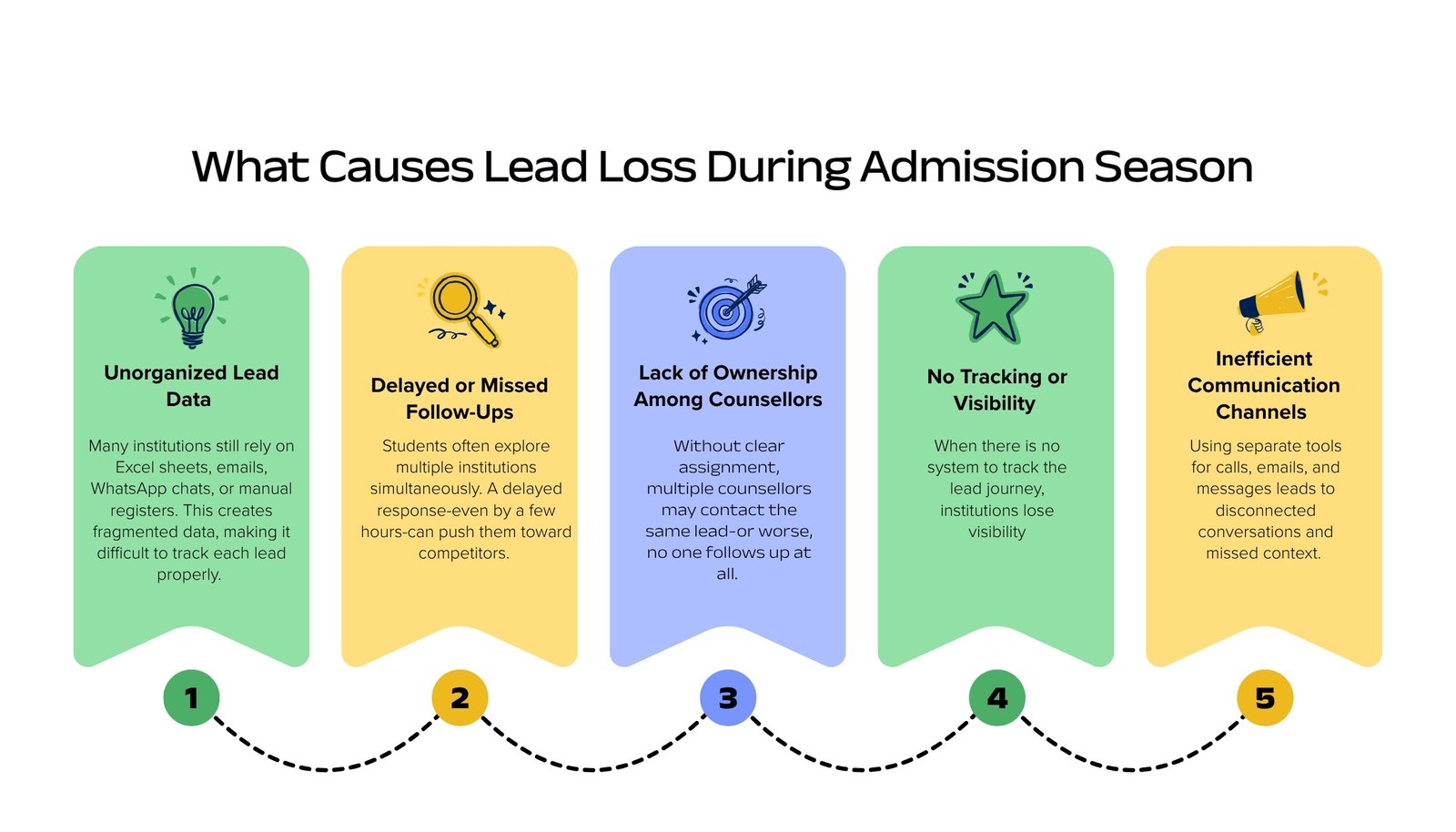
Understanding the root causes of lead loss is the first step toward solving it.
Unorganized Lead Data
This creates fragmented data, making it difficult to track each lead properly.
Delayed or Missed Follow-Ups
A delayed response-even by a few hours-can push them toward competitors.
Lack of Ownership Among Counsellors
Without clear assignment, multiple counsellors may contact the same lead-or worse, no one follows up at all.
No Tracking or Visibility
- Which stage the student is in
- What actions have been taken
- What needs to happen next
Inefficient Communication Channels
Using separate tools for calls, emails, and messages leads to disconnected conversations and missed context.
All these challenges create friction in the admission process, resulting in lost opportunities.
What is an Education CRM?
An Education CRM is a specialized software designed to manage the entire student lifecycle-from initial inquiry to enrollment and beyond
- Lead capture and tracking
- Admission workflow management
- Counsellor assignment
- Communication automation
- Reporting and analytics
In the context of CRM in higher education, it acts as a centralized system that brings together marketing, admissions, and communication processes into one platform.
Centralized Lead Capture with Lead Management CRM
Lead Sources Integrated:
- Website forms
- Phone calls
- Social media platforms
- Email inquiries
- Walk-in
Key Benefits:
- No duplication of leads
- No missing data
- Easy access for the entire team
- Better tracking from day one
Smart Lead Distribution and Ownership
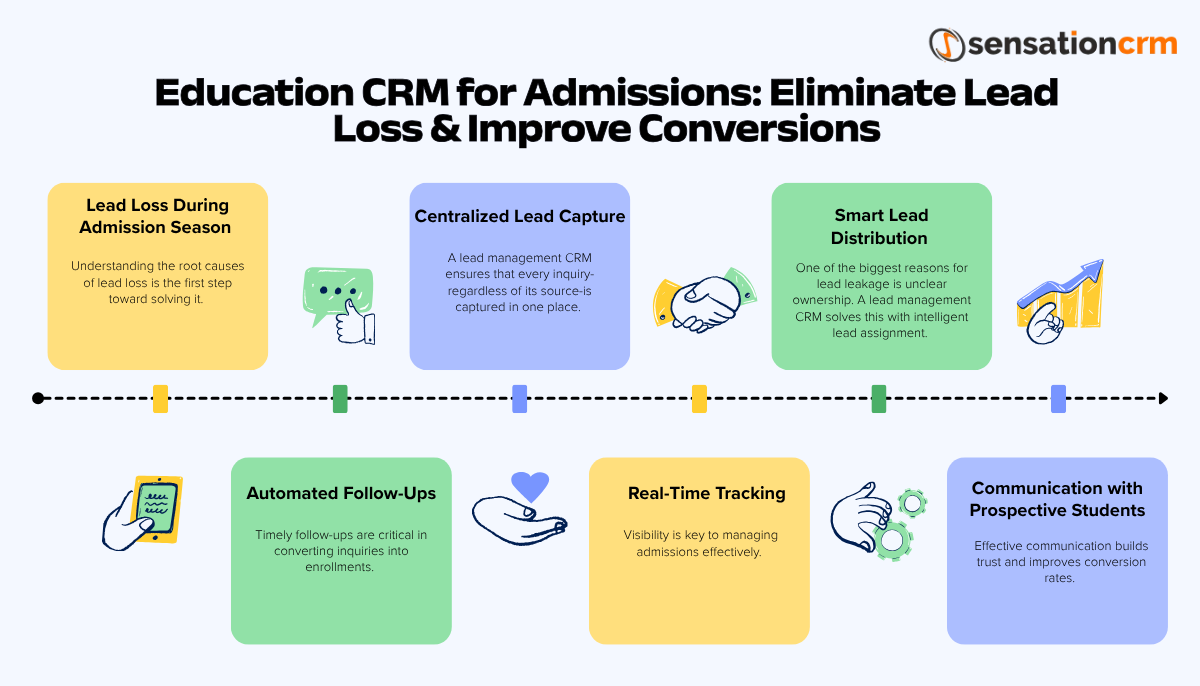
One of the biggest reasons for lead leakage is unclear ownership. A lead management CRM solves this with intelligent lead assignment.
How It Works:
- Leads are automatically assigned to counsellors
- Distribution can be based on rules (location, course, workload)
- Role-based access ensures accountability
Impact:
- Faster response times
- Clear responsibility for each lead
- No overlap or confusion
Automated Follow-Ups and Reminders
Timely follow-ups are critical in converting inquiries into enrollments.
An Education CRM automates this process through:
Automation Features:
- Scheduled email campaigns
- SMS reminders
- Call follow-up alerts
- Task notifications for counsellors
Why It Matters:
- Ensures no lead is forgotten
- Maintains consistent communication
- Keeps prospects engaged throughout the decision-making process
Automation reduces dependency on manual effort and ensures every lead is nurtured at the right time.
Real-Time Tracking and Visibility
Visibility is key to managing admissions effectively.
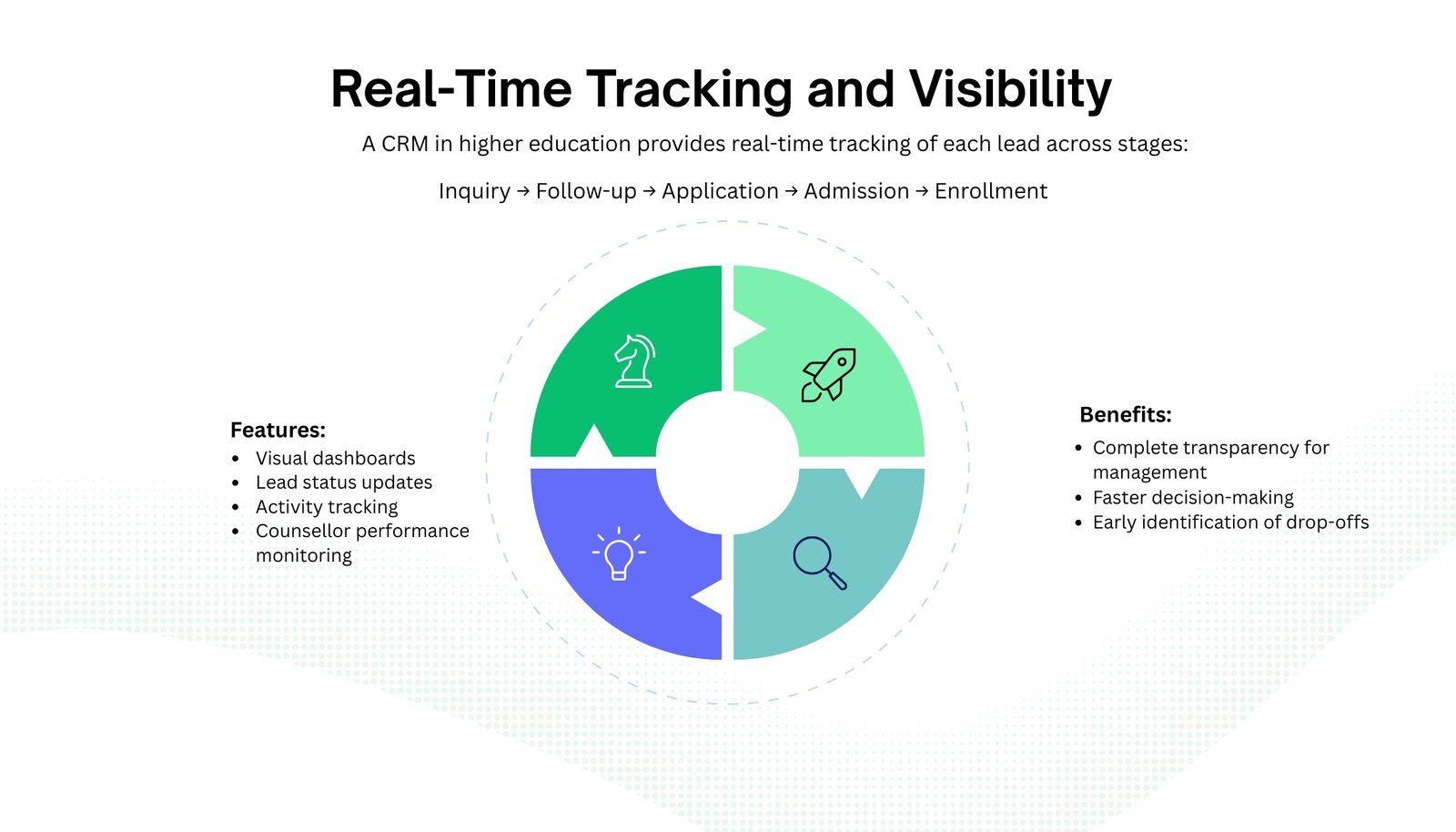
A CRM in higher education provides real-time tracking of each lead across stages:
Inquiry → Follow-up → Application → Admission → Enrollment
Features:
- Visual dashboards
- Lead status updates
- Activity tracking
- Counsellor performance monitoring
Benefits:
- Complete transparency for management
- Faster decision-making
- Early identification of drop-offs
Institutions can instantly see where leads are getting stuck and take corrective actions.
Improved Communication with Prospective Students
Effective communication builds trust and improves conversion rates.
An Education CRM centralizes all communication channels:
Unified Communication Includes:
- Call logs
- Email history
- WhatsApp messages
- Notes from counsellors
Advantages:
- Personalized interactions
- Context-aware conversations
- Consistent messaging across channels
Students receive timely, relevant information, which enhances their experience and increases the likelihood of enrollment.
Data-Driven Insights to Reduce Lead Loss
Data is one of the most powerful tools in preventing lead loss.
A lead management CRM provides actionable insights through detailed reports:
Key Reports:
- Lead source performance
- Conversion rates
- Campaign effectiveness
- Counsellor productivity
How It Helps:
- Identify which channels bring high-quality leads
- Detect bottlenecks in the admission funnel
- Optimize strategies in real time
Benefits of Using CRM in Higher Education
Implementing a CRM in higher education delivers measurable improvements:
Reduced Lead Leakage
Centralized tracking ensures no inquiry is missed.
Faster Response Time
Automation and smart assignment enable quick responses.
Higher Conversion Rates
Consistent follow-ups and personalized communication improve outcomes.
Better Team Coordination
All departments work on the same system with shared visibility.
Scalable Admission Process
Institutions can handle increased lead volume without operational breakdo
Best Practices to Maximize CRM Effectiveness
Simply implementing an Education CRM is not enough. To get maximum value, institutions must follow best practices:
Train Your Admission Team
Ensure counsellors understand how to use the CRM effectively.
Set Clear Workflows
Define processes for lead handling, follow-ups, and status updates.
Monitor Dashboards Regular
Use Automation Smartly
Keep Data Updated
Accurate and updated data ensures reliable insights and smooth operation
Admission Season is more Chaotic
Admission success is not just about generating more inquiries, it is about managing every opportunity effectively.
A modern admissions CRM helps institutions create a more organized and student-focused enrollment process. By combining automation, visibility, and personalized communication, colleges and universities can reduce lead loss, improve team productivity, and convert more prospective students into enrolled learners.
As competition for student enrollment continues to grow, institutions that invest in efficient admission management systems will be better positioned to deliver exceptional experiences and achieve sustainable enrollment growth.
The key takeaway:
Institutions that implement a strong CRM in higher education don’t just manage leads, they build structured, efficient systems that consistently convert them into enrollments. For more information, contact us to explore how the right solution can transform your admissions process.
Leave a Reply