Education CRM Software vs Generic CRM: Key Differences Explained
Build for the Student Lifecycle
Education CRM software is designed to support the complete student journey. From the first inquiry to enrollment and post-admission engagement, every stage is connected within a single system.
Unlike traditional buyers, students rarely make quick decisions. They often compare institutions, ask multiple questions, and take time before applying. Some may even pause their decision-making process and return weeks later.
Education CRM Software Admissions Workflow Support
Admissions workflows involve more than just “open” and “closed” stages. There are document checks, eligibility confirmations, fee discussions, seat availability concerns, and academic approvals. An education CRM solution includes these workflows by default, so teams can move students through each stage without confusion. Generic CRMs usually require heavy customization to replicate this, and even then, the process often feels forced or incomplete.
Education CRM Education Parent Student Communication Handling
In education, communication is rarely one-to-one. Parents, guardians, and sometimes sponsors are involved in the decision-making process. Education CRM software allows institutions to manage multiple contacts linked to a single student profile. This ensures that updates reach the right people at the right time. Generic CRMs usually treat each contact as an individual buyer, which can result in fragmented communication and missing context.
CRM is built to support counselors rather than sales representatives. It tracks counselor assignments, follow-ups, workloads, and response times in a way that reflects academic counseling rather than sales pressure. This helps institutions ensure fair distribution of inquiries and consistent follow-ups. Generic CRMs focus on deal ownership and sales quotas, which don’t translate well to counseling environments.
Academic Reporting and Insights
Education-focused reporting looks very different from sales reporting. Institutions need to understand which programs attract the most interest, where students drop off in the admission process, how long decisions take, and which counselors need support. An education CRM solution provides these insights in a usable, institution-ready format. Generic CRMs mainly report on revenue forecasts and pipeline velocity, which offer limited value in academic decision-making.
Compliance and Data Sensitivity
Educational institutions handle sensitive student information that must be protected carefully. Education CRM software is designed with this responsibility in mind, offering role-based access, audit trails, and controlled data visibility. This ensures that staff members only see the information relevant to their role. Generic CRMs can be secured, but compliance is not their primary design focus, making them riskier if not managed carefully.
Reduced Customization Dependency
One common issue with generic CRMs is the need for extensive customization to fit education workflows. Over time, this creates dependency on technical teams and increases maintenance costs. Education CRM software already understands academic structures, making it an ideal solution for schools, colleges, and coaching institutes that need stability rather than constant configuration.
Higher Student Adoption Rates
Admissions teams are more likely to use a system that feels intuitive and aligned with their daily tasks. Education CRM software mirrors how counselors already work, which leads to higher adoption and better data quality through effective student management. Generic CRMs often feel foreign to academic staff, lacking proper student management controls and causing teams to fall back on spreadsheets or personal notes, which defeats the purpose of having a CRM at all.
Scalability Without Operational Chaos
As institutions grow, they face higher inquiry volumes, more programs, and larger counseling teams. Education CRM scales without disrupting existing workflows, maintaining structure even as complexity increases. Generic CRMs can scale technically, but without proper academic logic, they often create confusion as the institution grows.
Cost vs Long-Term Value
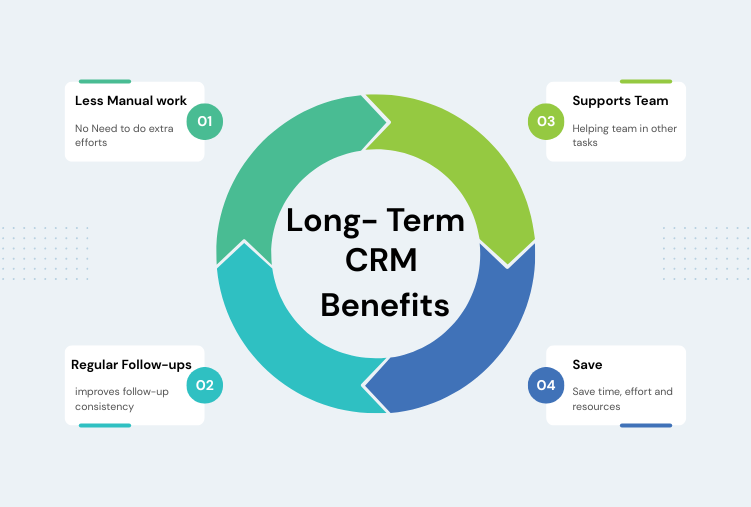
While generic CRMs may appear cheaper initially, the long-term costs of customization, training, and inefficiency often outweigh the savings. Education CRM software delivers better value over time because it reduces manual work, improves follow-up consistency, and supports admissions teams more effectively. Institutions end up saving time, effort, and resources in the long run.
Why This Difference Matters in Practice
Choosing between a generic CRM and education CRM isn’t just a technical decision. It directly affects how smoothly admissions teams operate, how effectively lead management is handled, how students experience the institution, and how leadership makes decisions. A system built for education reduces friction and supports sustainable growth.
Final Thought
Education institutions don’t need to force their processes into a sales-oriented system. They need tools that respect how education actually works.
Sensation CRM is designed specifically for academic environments, supporting admissions workflows, counselor operations, and institutional reporting without unnecessary complexity. For schools, colleges, and coaching institutes that value clarity, accountability, and long-term scalability, using an education-focused CRM makes everyday work simpler and more effective.
Education CRM Software vs Generic CRM: Key Differences Explained
Built for The Student Lifecycle
EDUCATION CRM software is designed to support the complete student journey. From the first inquiry to enrollment and post-admission engagement, every stage is connected within a single system.
Unlike traditional buyers, students rarely make quick decisions. They often compare institutions, ask multiple questions, and take time before applying. Some may even pause their decision-making process and return weeks later.
EDUCATION CRM Admissions Workflow Support
Admissions workflows involve more than just “open” and “closed” stages. There are document checks, eligibility confirmations, fee discussions, seat availability concerns, and academic approvals. An education CRM solution includes these workflows by default, so teams can move students through each stage without confusion. Generic CRMs usually require heavy customization to replicate this, and even then, the process often feels forced or incomplete.
EDUCATION CRM Parent Student Communication Handling
EDUCATION CRM In education, communication is rarely one-to-one. Parents, guardians, and sometimes sponsors are involved in the decision-making process. CRM software allows institutions to manage multiple contacts linked to a single student profile. This ensures that updates reach the right people at the right time. Generic CRMs usually treat each contact as an individual buyer, which can result in fragmented communication and missing context.
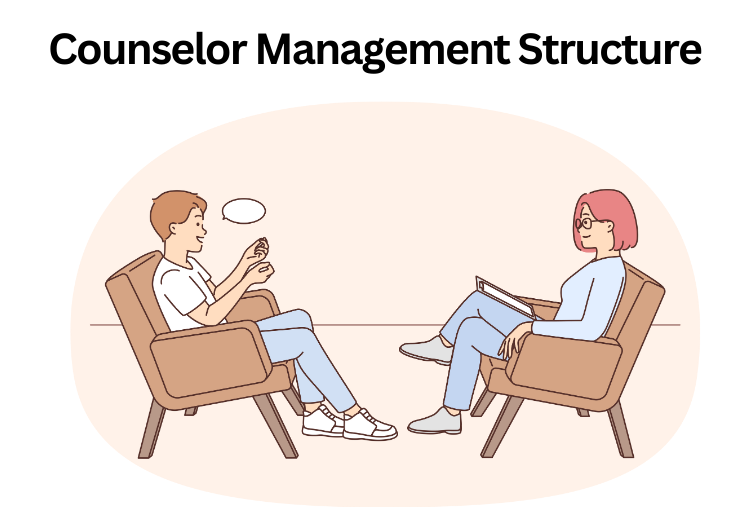
EDUCATION CRM Counselor Management Structure
CRM software is built to support counselors rather than sales representatives. It tracks counselor assignments, follow-ups, workloads, and response times in a way that reflects academic counseling rather than sales pressure. This helps institutions ensure fair distribution of inquiries and consistent follow-ups. Generic CRMs focus on deal ownership and sales quotas, which don’t translate well to counseling environments.
Academic Reporting and Insights
Education-focused reporting looks very different from sales reporting. Institutions need to understand which programs attract the most interest, where students drop off in the admission process, how long decisions take, and which counselors need support. An CRM solution provides these insights in a usable, institution-ready format. Generic CRMs mainly report on revenue forecasts and pipeline velocity, which offer limited value in academic decision-making.
Compliance and Data Sensitivity
Educational institutions handle sensitive student information that must be protected carefully. CRM software is designed with this responsibility in mind, offering role-based access, audit trails, and controlled data visibility. This ensures that staff members only see the information relevant to their role. Generic CRMs can be secured, but compliance is not their primary design focus, making them riskier if not managed carefully.
Reduced Customization Dependency
One common issue with generic CRMs is the need for extensive customization to fit education workflows. Over time, this creates dependency on technical teams and increases maintenance costs. Education CRM software already understands academic structures, making it an ideal solution for schools, colleges, and coaching institutes that need stability rather than constant configuration.
Higher Student Adoption Rates
Admissions teams are more likely to use a system that feels intuitive and aligned with their daily tasks. Education CRM software mirrors how counselors already work, which leads to higher adoption and better data quality through effective student management. Generic CRMs often feel foreign to academic staff, lacking proper student management controls and causing teams to fall back on spreadsheets or personal notes, which defeats the purpose of having a CRM at all.
Scalability Without Operational Chaos
As institutions grow, they face higher inquiry volumes, more programs, and larger counseling teams. Education CRM software scales without disrupting existing workflows, maintaining structure even as complexity increases. Generic CRMs can scale technically, but without proper academic logic, they often create confusion as the institution grows.
Cost vs Long-Term Value
While generic CRMs may appear cheaper initially, the long-term costs of customization, training, and inefficiency often outweigh the savings. Education CRM software delivers better value over time because it reduces manual work, improves follow-up consistency, and supports admissions teams more effectively. Institutions end up saving time, effort, and resources in the long run.
Why This Difference Matters in Practice
Choosing between a generic CRM and education CRM software isn’t just a technical decision. It directly affects how smoothly admissions teams operate, how effectively lead management is handled, how students experience the institution, and how leadership makes decisions. A system built for education reduces friction and supports sustainable growth.
Final Thought
Education institutions don’t need to force their processes into a sales-oriented system. They need tools that respect how education actually works.
Sensation CRM is designed specifically for academic environments, supporting admissions workflows, counselor operations, and institutional reporting without unnecessary complexity. For schools, colleges, and coaching institutes that value clarity, accountability, and long-term scalability, using an education-focused CRM makes everyday work simpler and more effective.
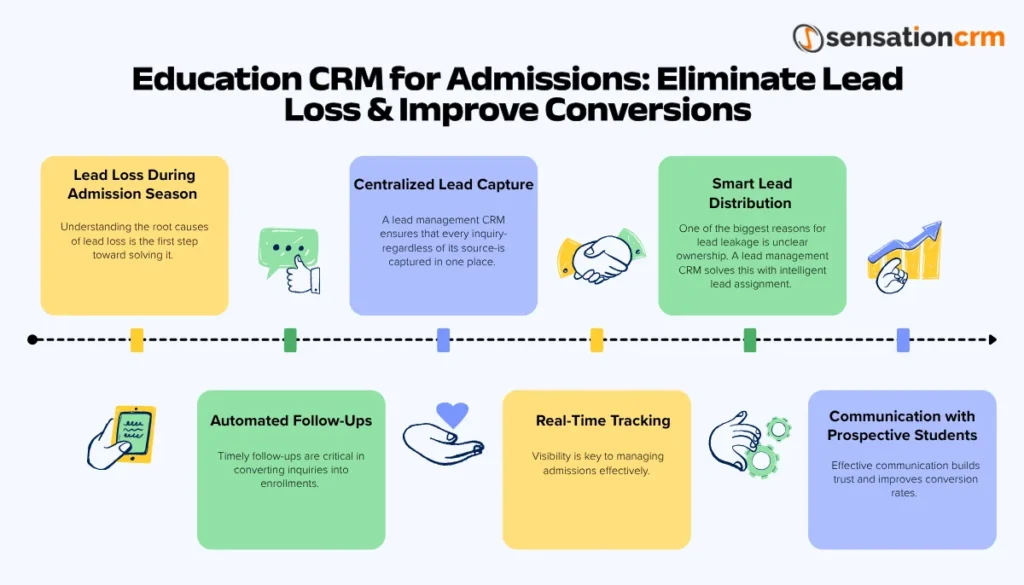
Admission season can be one of the busiest periods for educational institutions. With inquiries arriving from websites, social media, phone calls, and email campaigns, admission teams often struggle to keep up with growing volumes of student interest.
This is where an admissions CRM plays a vital role. By centralizing data, automating routine tasks, and improving visibility across the admission funnel, institutions can reduce lead loss and improve enrollment outcomes.
This is where an Education CRMbecomes essential. A well-implemented CRM in higher education centralizes processes, automates communication, and ensures no lead is ignored-helping institutions manage high volumes efficiently and convert more inquiries into admissions.
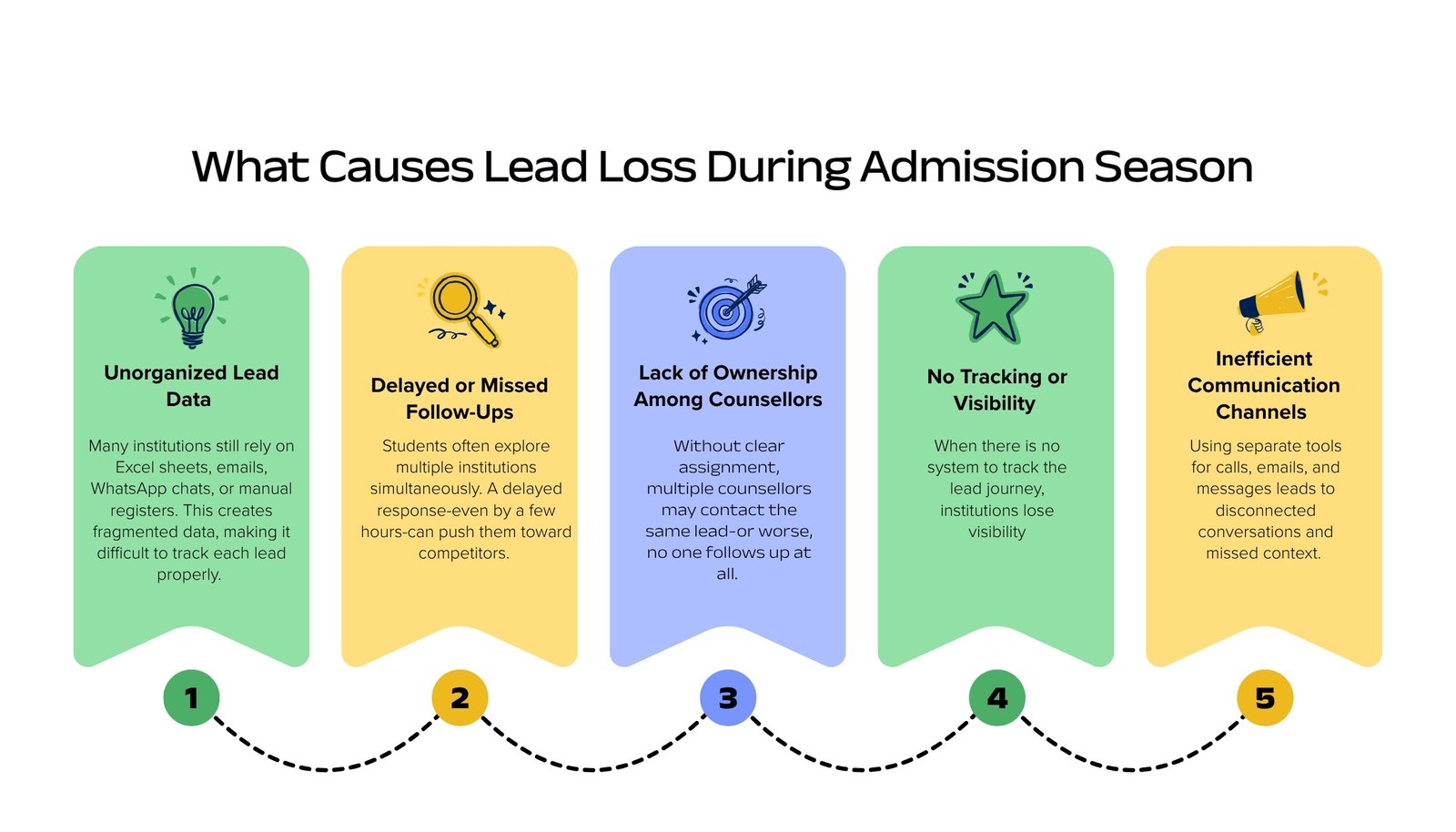
Understanding the root causes of lead loss is the first step toward solving it.
An Education CRM is a specialized software designed to manage the entire student lifecycle-from initial inquiry to enrollment and beyond
Lead capture and tracking
Admission workflow management
Communication automation
Reporting and analytics
In the context of CRM in higher education, it acts as a centralized system that brings together marketing, admissions, and communication processes into one platform.
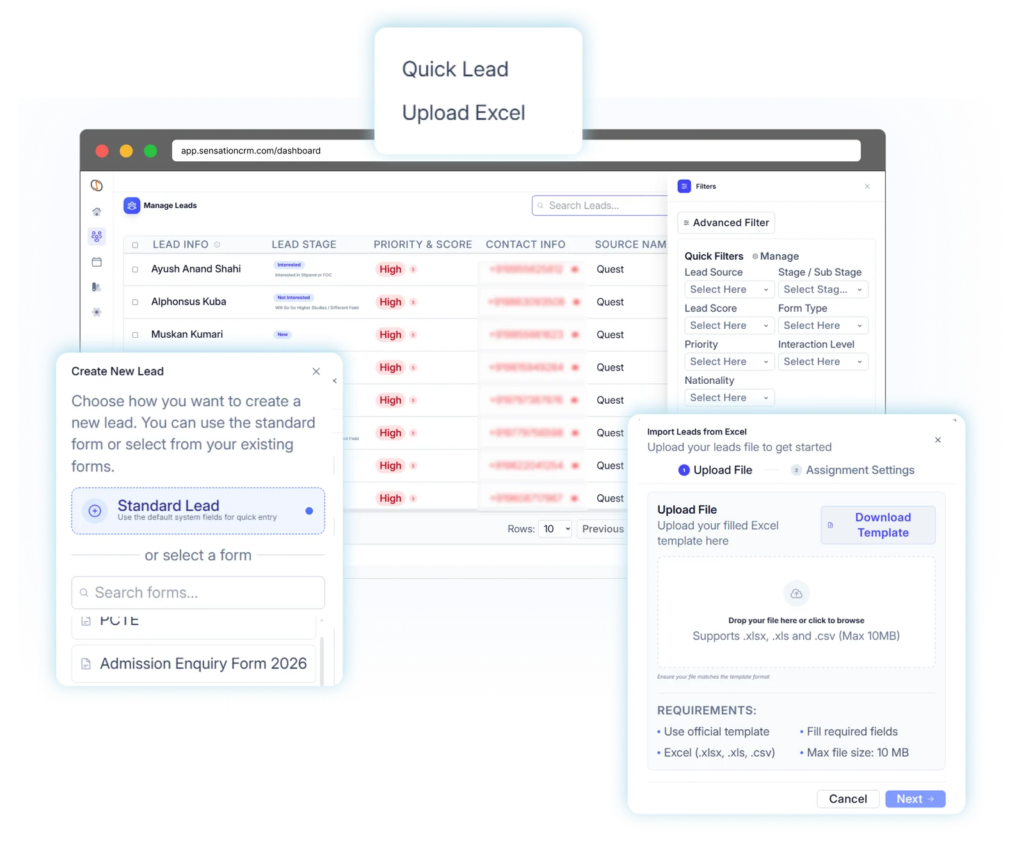
Centralized Lead Capture with Lead Management CRM
Lead Sources Integrated:
Website forms
Phone calls
Social media platforms
Email inquiries
Walk-in
Key Benefits:
No duplication of leads
No missing data
Easy access for the entire team
Better tracking from day one
Smart Lead Distribution and Ownership
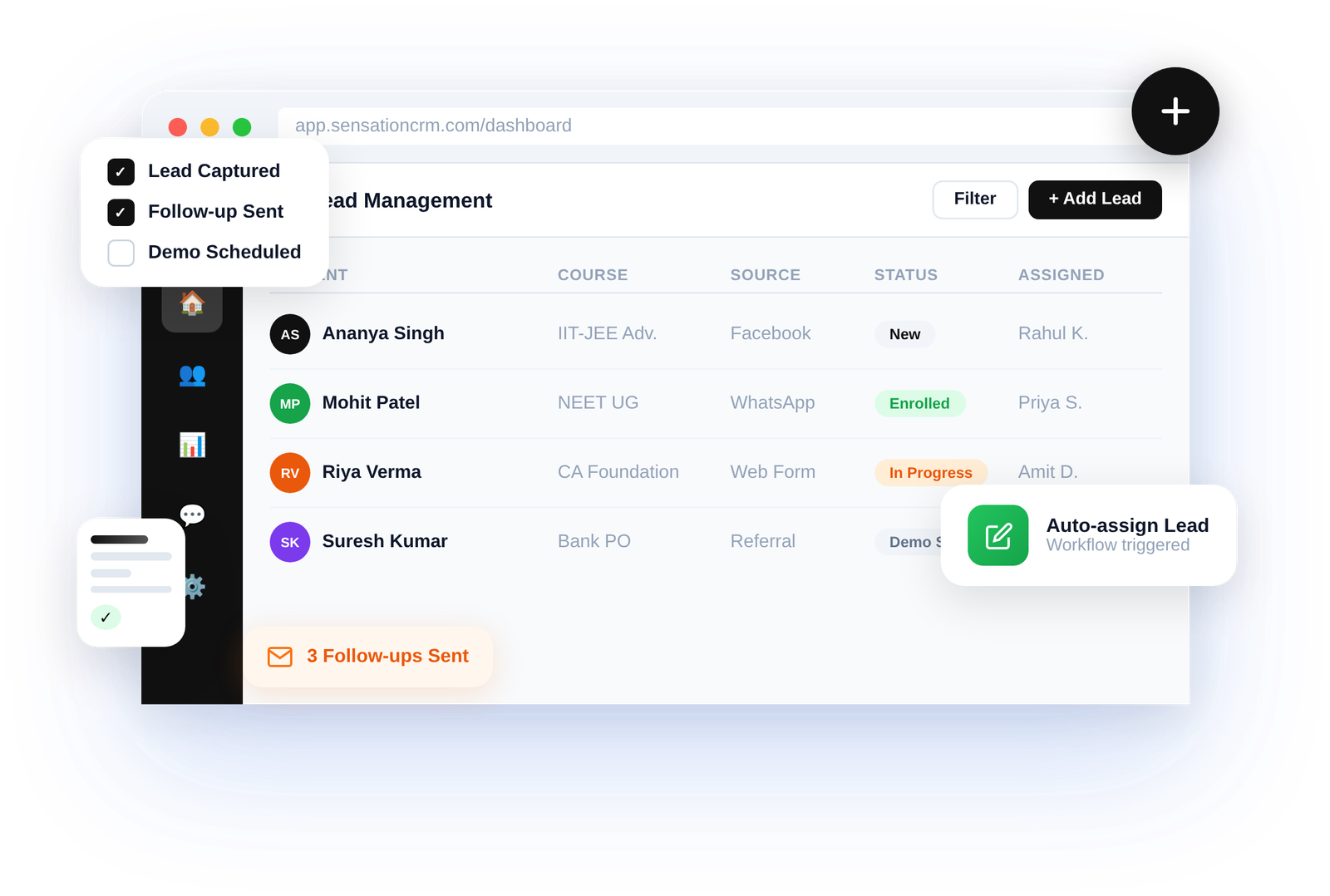
One of the biggest reasons for lead leakage is unclear ownership. A lead management CRM solves this with intelligent lead assignment.
How It Works:
Leads are automatically assigned to counsellors
Distribution can be based on rules (location, course, workload)
Role-based access ensures accountability
Impact:
Faster response times
Clear responsibility for each lead
No overlap or confusion
Automated Follow-Ups and Reminders
Timely follow-ups are critical in converting inquiries into enrollments.
An Education CRM automates this process through:
Automation Features:
Scheduled email campaigns
SMS reminders
Call follow-up alerts
Task notifications for counsellors
Why It Matters:
Ensures no lead is forgotten
Maintains consistent communication
Keeps prospects engaged throughout the decision-making process
Automation reduces dependency on manual effort and ensures every lead is nurtured at the right time.
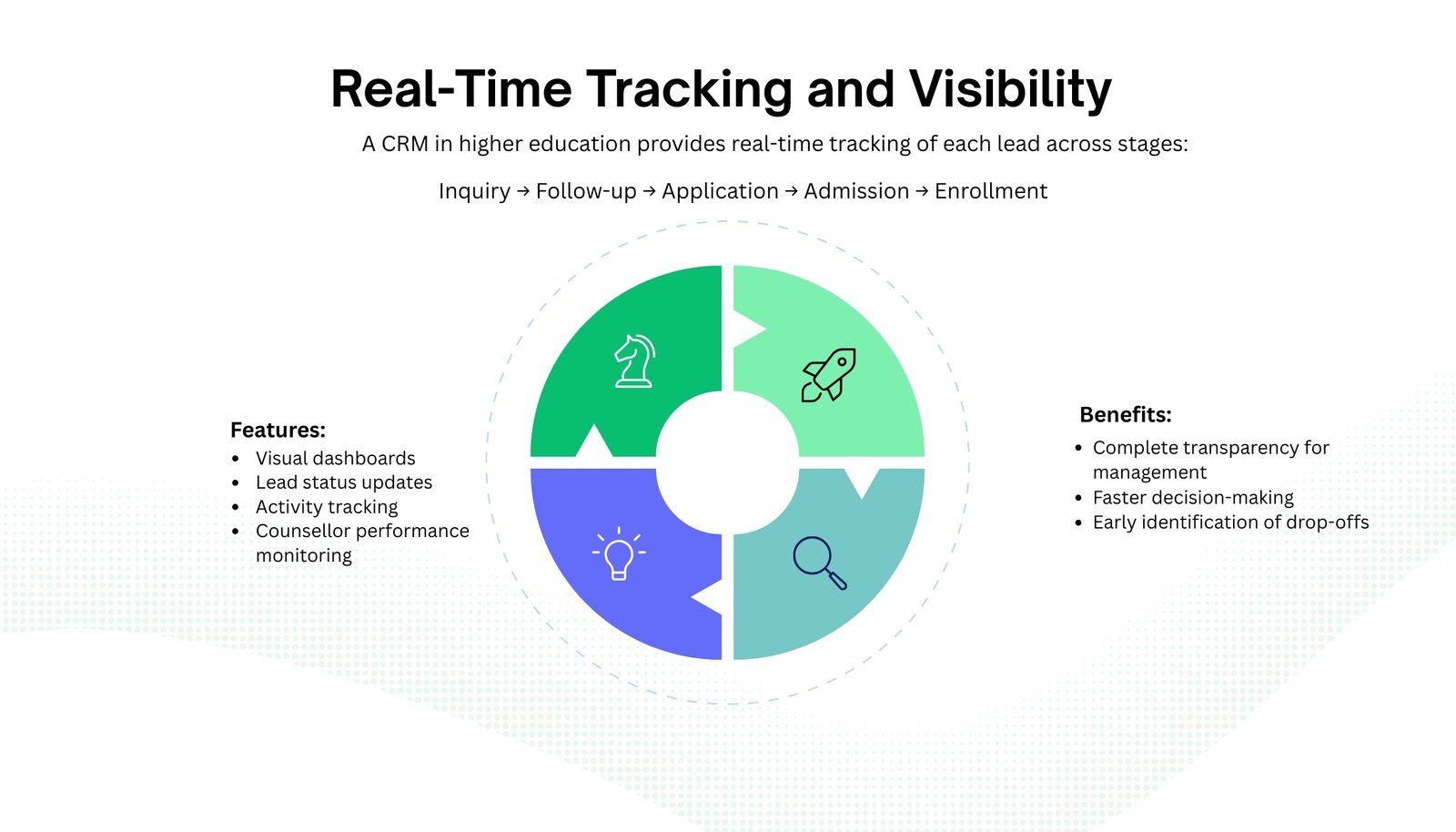
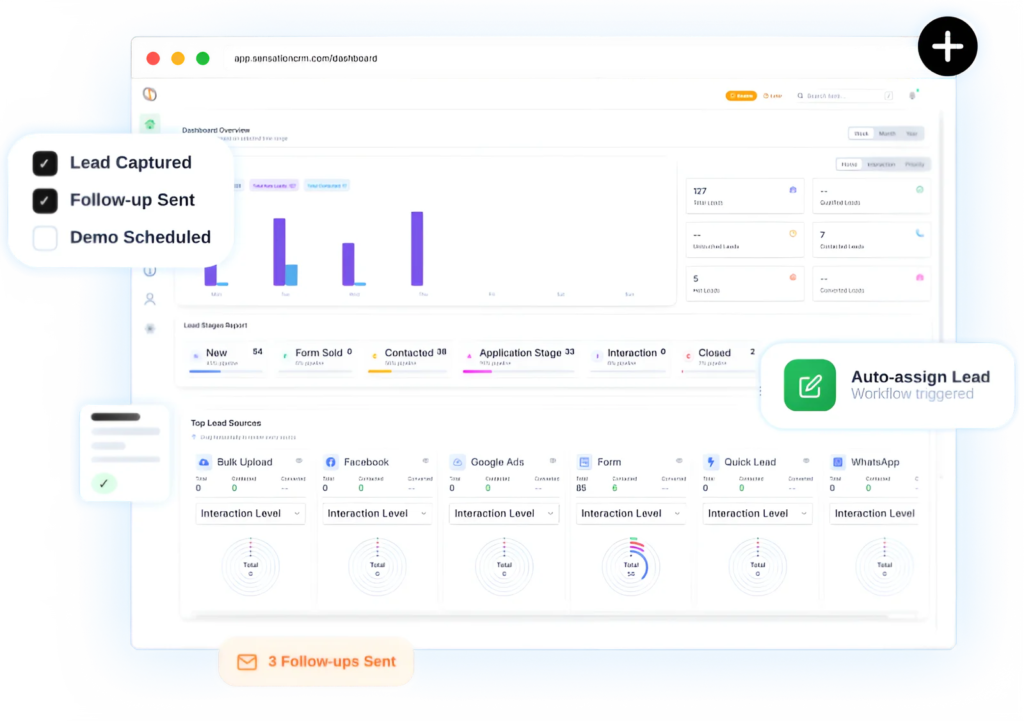
Real-Time Tracking and Visibility
Visibility is key to managing admissions effectively.
A CRM in higher education provides real-time tracking of each lead across stages:
Institutions can instantly see where leads are getting stuck and take corrective actions.
Improved Communication with Prospective Students
Effective communication builds trust and improves conversion rates.
An Education CRM centralizes all communication channels:
Unified Communication Includes:
Call logs
Email history
WhatsApp messages
Notes from counsellors
Advantages:
Personalized interactions
Context-aware conversations
Consistent messaging across channels
Students receive timely, relevant information, which enhances their experience and increases the likelihood of enrollment.
Data-Driven Insights to Reduce Lead Loss
Data is one of the most powerful tools in preventing lead loss.
A lead management CRM provides actionable insights through detailed reports:
Key Reports:
Lead source performance
Conversion rates
Campaign effectiveness
Counsellor productivity
How It Helps:
Identify which channels bring high-quality leads
Detect bottlenecks in the admission funnel
Optimize strategies in real time
Benefits of Using CRM in Higher Education
Implementing a CRM in higher education delivers measurable improvements:
Reduced Lead Leakage
Centralized tracking ensures no inquiry is missed.
Faster Response Time
Automation and smart assignment enable quick responses.
Higher Conversion Rates
Consistent follow-ups and personalized communication improve outcomes.
Better Team Coordination
All departments work on the same system with shared visibility.
Scalable Admission Process
Institutions can handle increased lead volume without operational breakdo
Best Practices to Maximize CRM Effectiveness
Simply implementing an Education CRM is not enough. To get maximum value, institutions must follow best practices:
Train Your Admission Team
Ensure counsellors understand how to use the CRM effectively.
Set Clear Workflows
Define processes for lead handling, follow-ups, and status updates.
Monitor Dashboards Regular
Use Automation Smartly
Keep Data Updated
Accurate and updated data ensures reliable insights and smooth operation
Admission Season is more Chaotic
Admission success is not just about generating more inquiries, it is about managing every opportunity effectively.
A modern admissions CRM helps institutions create a more organized and student-focused enrollment process. By combining automation, visibility, and personalized communication, colleges and universities can reduce lead loss, improve team productivity, and convert more prospective students into enrolled learners.
As competition for student enrollment continues to grow, institutions that invest in efficient admission management systems will be better positioned to deliver exceptional experiences and achieve sustainable enrollment growth.
The key takeaway:
Institutions that implement a strong CRM in higher education don’t just manage leads, they build structured, efficient systems that consistently convert them into enrollments. For more information, contact us to explore how the right solution can transform your admissions process.
Education CRM vs ERP: What’s the Difference and What Do Educational Institutions Really Need?
Educational institutions today manage far more than admissions and academic records. Schools, colleges, universities, coaching centres, and education consultancies must handle student inquiries, admissions, communication, fee collection, academic operations, marketing campaigns, reporting, and stakeholder engagement simultaneously.
As institutions become increasingly digital, two software categories often dominate technology discussions: Education CRM and ERP systems. While both platforms help streamline operations, they serve very different purposes
Many institutions searching for the right technology solution often ask whether they need a CRM, an ERP, or both. Understanding the differences between these systems is essential for making informed decisions that support student recruitment, operational efficiency, and long-term institutional growth. Implementing the right education CRM software can help institutions streamline admissions, improve student engagement, and enhance enrollment outcomes.
Why Educational Institutions Need Digital Management Systems
The modern student journey begins long before enrollment. Prospective students interact with websites, social media platforms, education portals, WhatsApp, email campaigns, webinars, and counselors before making admission decisions.
At the same time, institutions must manage academics, finance, examinations, attendance, faculty operations, student records, and administrative processes.
Managing these functions manually often leads to:
Lost student inquiries
Delayed follow-ups
Disconnected data
Inefficient communication
Limited visibility into admissions performance
Operational bottlenecks
This is where technologies like education CRM software and ERP systems help institutions centralize processes and improve efficiency.
What Is CRM for Education?
This is one of the most common questions educational institutions ask.
A Customer Relationship Management (CRM) system designed for education focuses primarily on student recruitment, admissions, communication, lead management, and relationship building.
An education CRM helps institutions manage prospective student interactions from the first inquiry through enrollment and beyond.
Unlike traditional business CRMs, a CRM for education industry is specifically designed to support admission workflows, student engagement, counselor management, marketing campaigns, and enrollment tracking. Understanding CRM for education features & checklist helps institutions select the right solution to streamline admissions and improve enrollment outcomes.
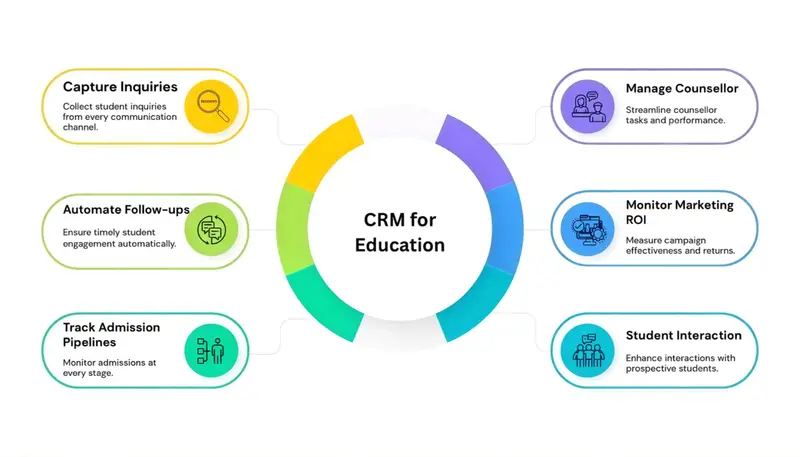
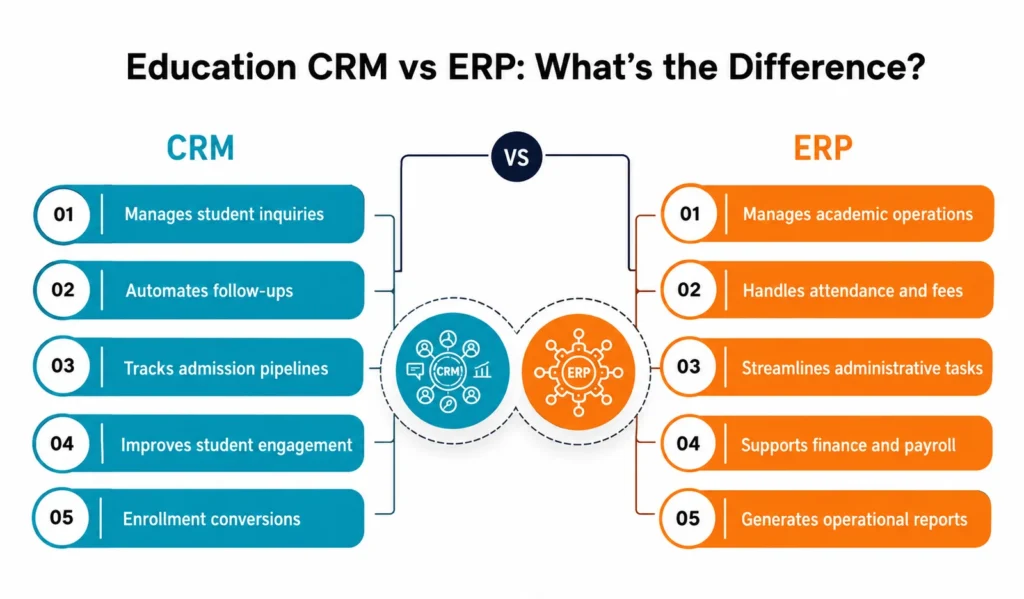
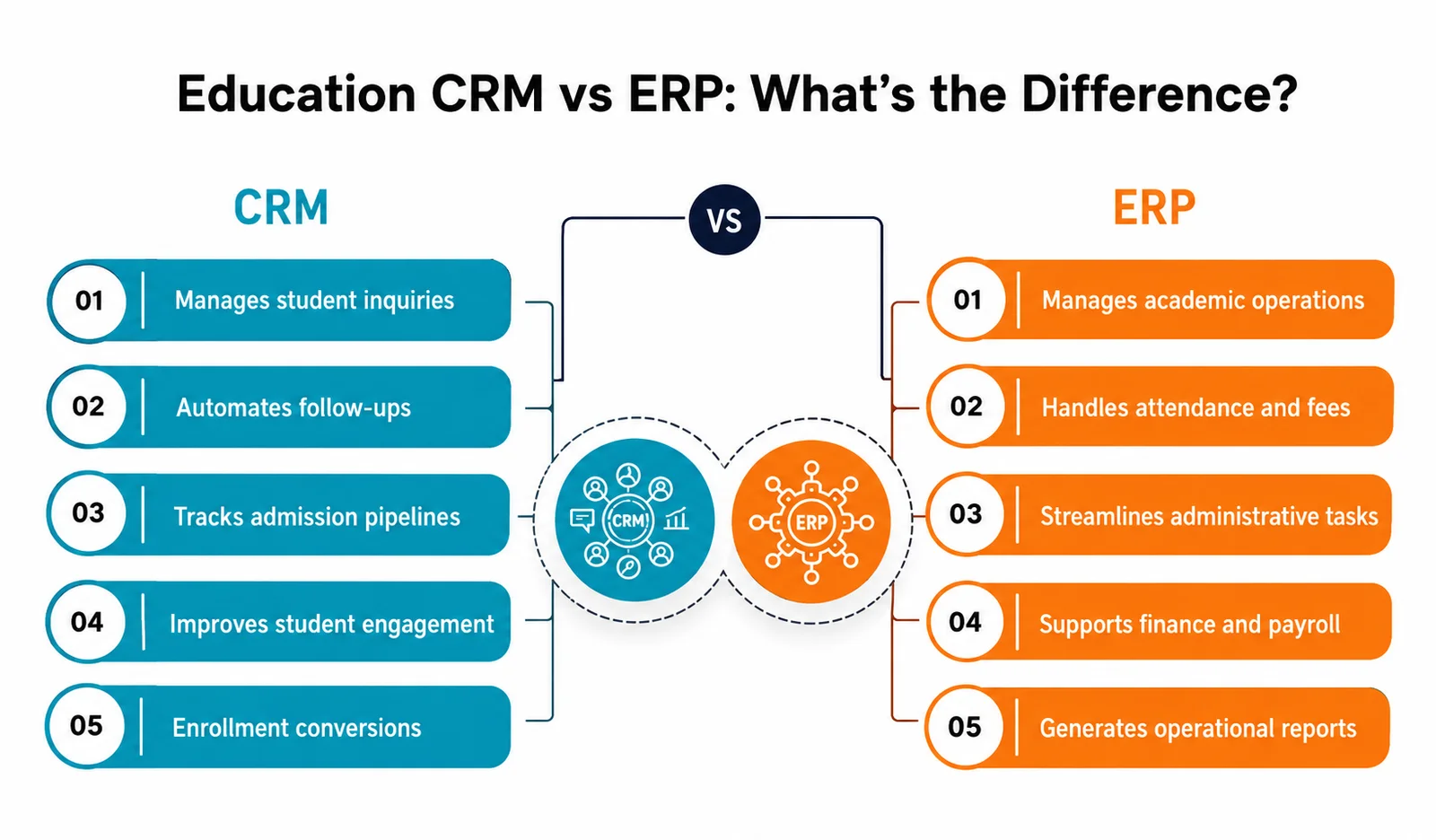
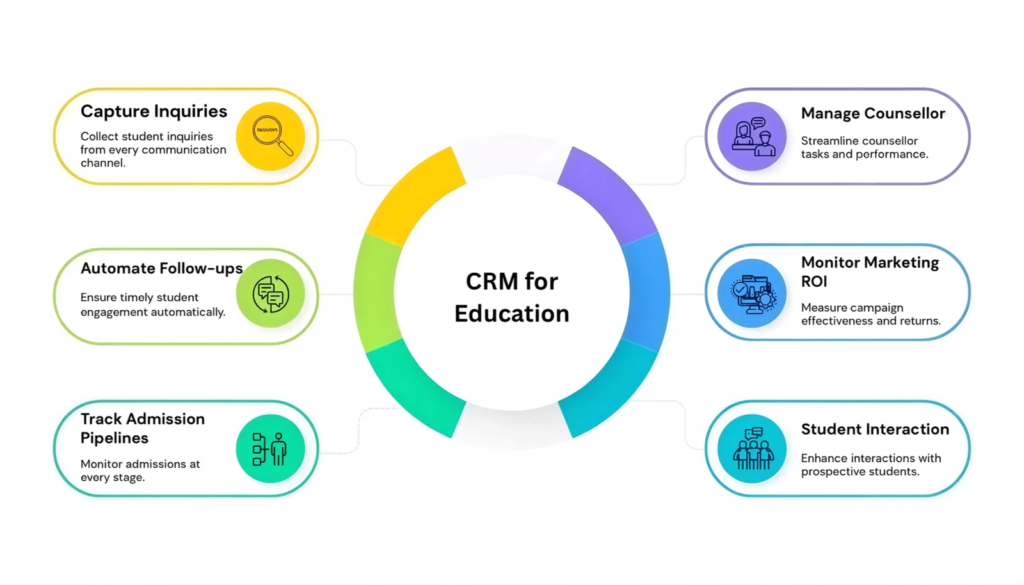
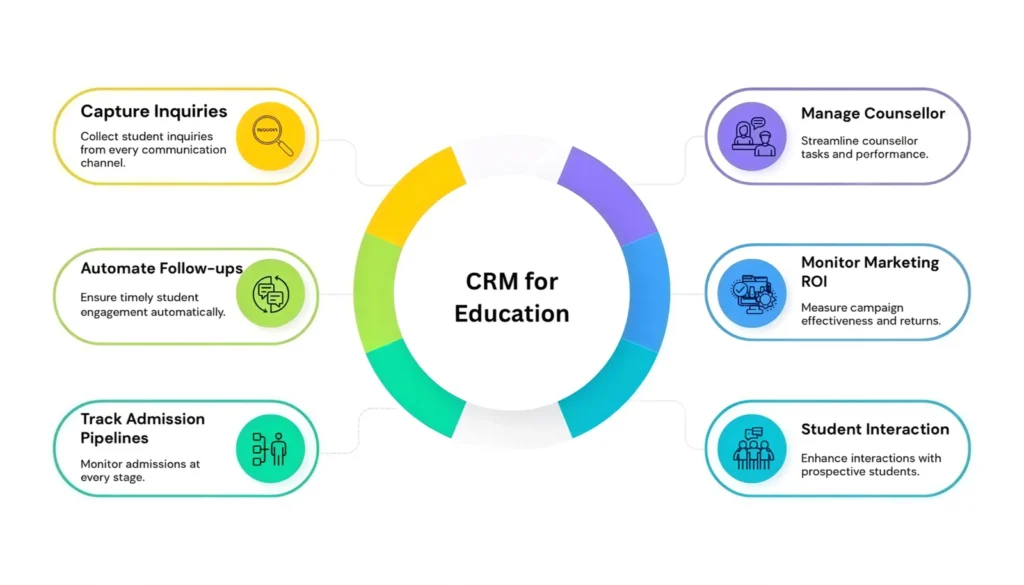
Educational institutions use CRM software to:
Capture inquiries from multiple channels
Automate follow-ups
Track admission pipelines
Manage counsellor activities
Monitor marketing ROI
Improve student communication
Increase enrollment conversions
A CRM focuses on helping institutions attract, engage, nurture, and convert prospective students more effectively.
What Is an ERP System in Education?
An Enterprise Resource Planning (ERP) system focuses on managing internal institutional operations. While CRM manages prospective student relationships, ERP manages the administrative and academic processes that occur after enrollment.
Educational ERP systems typically centralize:
Student records
Attendance management
Examination systems
Fee management
Human resources
Payroll
Timetable scheduling
Academic reporting
Library management
Faculty administration
ERP platforms are designed to improve operational efficiency by integrating multiple internal departments into a unified system.
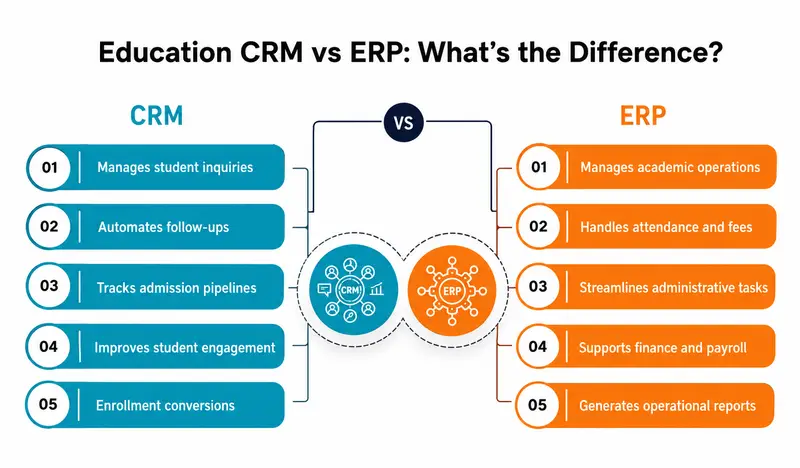
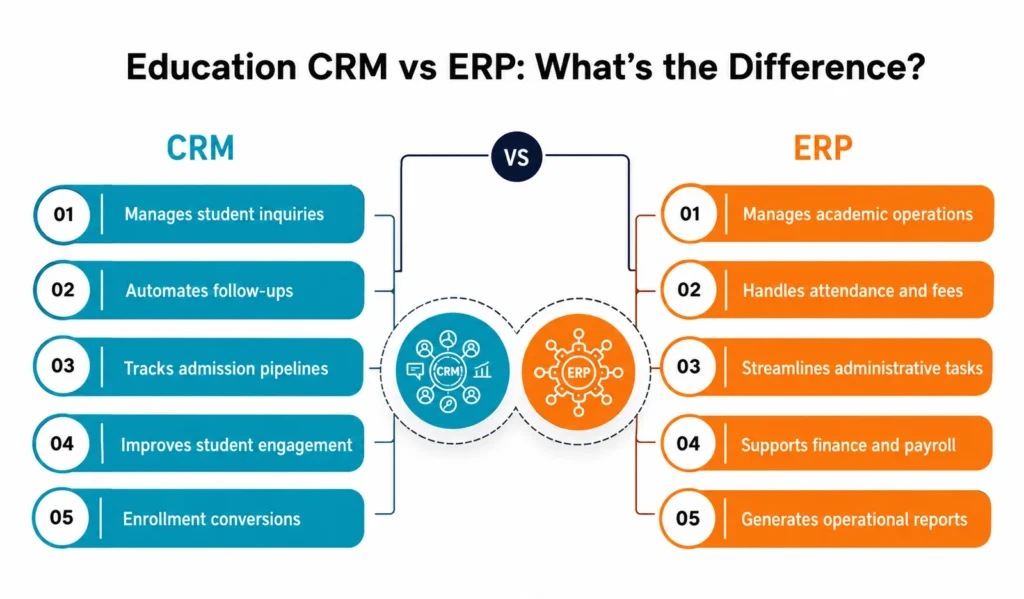
Education CRM vs ERP: Understanding the Core Difference
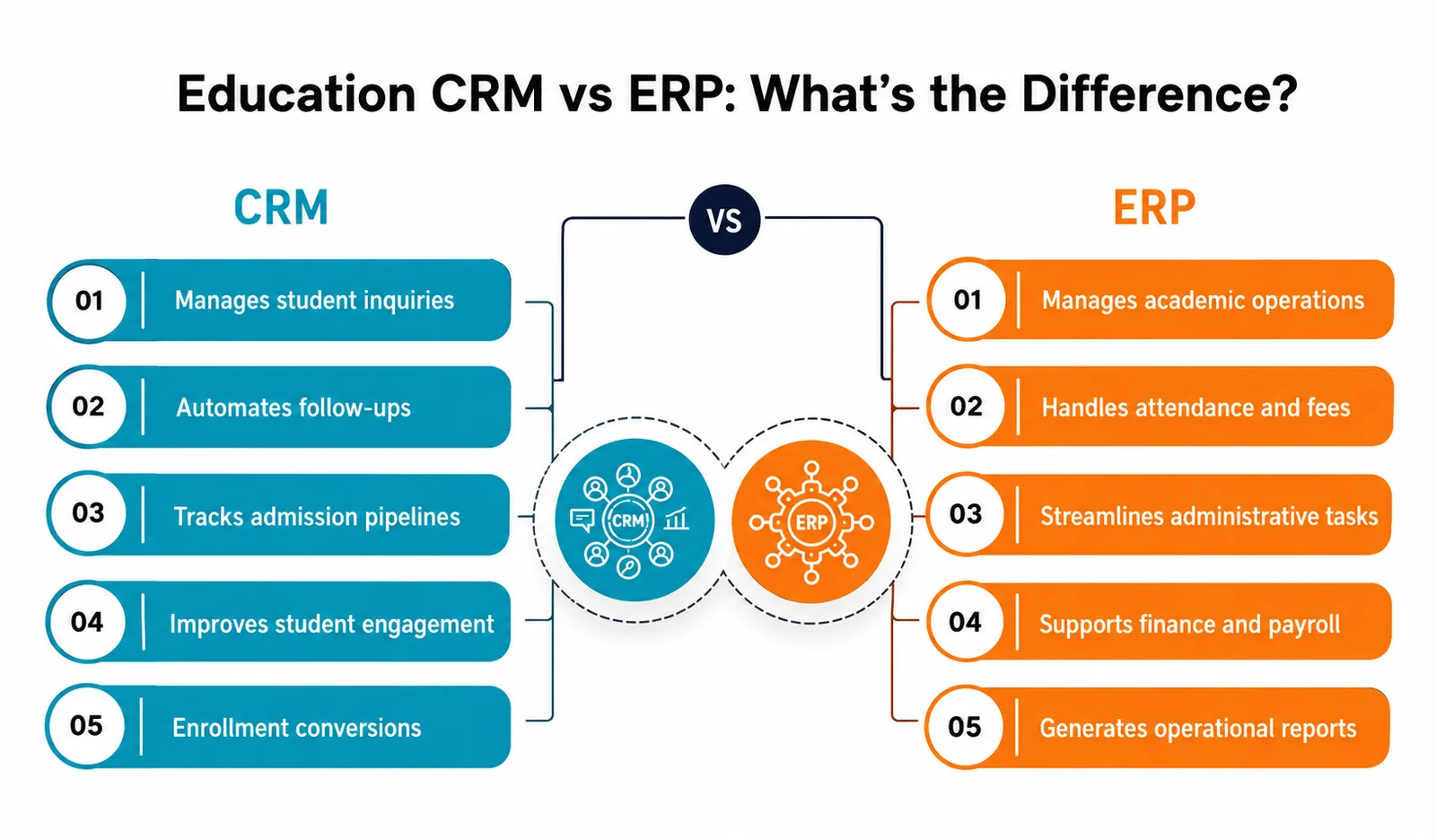
Although CRM and ERP systems often work together, their primary objectives are different.
Feature
Education CRM
Education ERP
Primary Focus
Student acquisition and admissions
Academic and administrative management
User Group
Admission teams, marketing teams, counselors
Faculty, administration, finance, HR
Inquiry Management
Yes
Limited
Lead Tracking
Yes
No
Marketing Automation
Yes
No
Student Communication
Extensive
Basic
Academic Operations
Limited
Yes
Attendance Management
No
Yes
Examination Management
No
Yes
Fee Management
Limited
Yes
Enrollment Analytics
Yes
Limited
Internal Administration
No
Yes
The simplest way to understand the difference is:
CRM helps institutions acquire students. ERP helps institutions manage students after enrollment.
Which Is Better CRM or ERP?
Another frequently searched question is:
Which Is Better CRM or ERP?
The answer depends entirely on the institution’s goals.
If your primary challenge involves generating inquiries, improving admissions, increasing enrollment conversions, and managing communication, a CRM is often the higher priority.
If your institution struggles with academic administration, student records, examinations, fee collection, and internal operations, an ERP may be more critical.
However, for most growing educational institutions, the question is not CRM versus ERP.
The real question is how both systems can work together to support the complete student lifecycle.
A CRM manages the pre-admission journey, while an ERP manages the post-admission experience.
Can ERP Replace CRM?
Many institutions assume that because ERP systems contain student information, they can eliminate the need for a CRM.
Can ERP Replace CRM?
In most cases, no.
ERP systems focus mainly on academic and operational management, whereas student acquisition, engagement and lead nurturing are better managed through an education CRM.
While some ERP platforms include basic communication features, they often lack advanced capabilities such as:
Lead capture automation
Admission funnel tracking
Marketing campaign management
Lead scoring
Counselor activity monitoring
Enrollment conversion reporting
Multi-channel communication workflows
These functions are central to modern admissions management and are typically handled more effectively through dedicated CRM platforms.
Does an ERP Include a CRM?
Some ERP providers offer basic CRM functionality within their platforms. However, these modules are usually limited compared to specialized education CRM solutions.
A built-in CRM module may allow institutions to record inquiries and manage basic communication, but advanced features such as automation, marketing attribution, AI-driven lead scoring, and enrollment analytics are often missing.
As competition for student recruitment increases, many institutions choose specialized CRM platforms to gain greater visibility into admissions performance and marketing effectiveness.
What Are the Five ERP Modules?
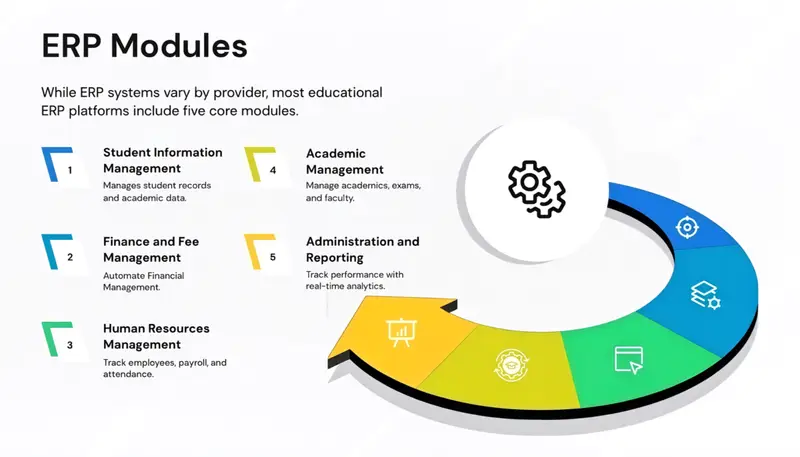
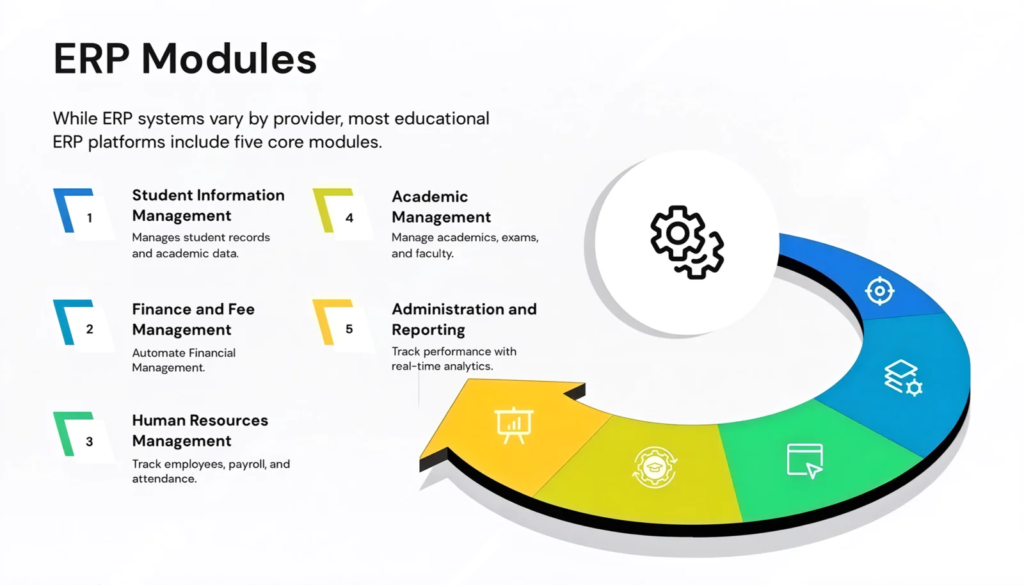
While ERP systems vary by provider, most educational ERP platforms include five core modules:
Student Information Management: This module manages student profiles, enrollment records, academic history, and institutional data.
Finance and Fee Management: Finance modules support fee collection, accounting, invoicing, budgeting, and financial reporting.
Human Resources Management: HR functionality manages employee records, recruitment, payroll, attendance, and performance tracking.
Academic Management: Academic modules support timetables, examinations, grading systems, curriculum planning, and faculty operations.
Administration and Reporting: Administrative modules provide reporting dashboards, operational analytics, compliance monitoring, and institutional performance insights.
Together, these modules create a centralized operational ecosystem for educational institutions.
Why Education CRM Is Becoming More Important in 2026
Student recruitment has become increasingly competitive across schools, colleges, universities, and education businesses. Prospective students expect personalized communication, immediate responses, and seamless digital experiences throughout the admission process.
Research consistently shows that institutions responding quickly to inquiries achieve significantly higher conversion rates than those relying on delayed manual follow-up processes.
As a result, educational institutions are investing heavily in CRM technologies that support admission automation, lead management, marketing attribution, AI-powered engagement, and student communication workflows.
The growing importance of digital-first recruitment strategies is making CRM software one of the most valuable technology investments for modern educational organizations.
How Sensation CRM Helps Educational Institutions
For institutions seeking a specialized solution for admissions and student engagement, Sensation CRM provides a purpose-built platform designed specifically for the education sector.
Unlike generic CRM platforms originally developed for corporate sales teams, Sensation CRM focuses on education-specific workflows and enrollment management processes.
The platform helps institutions:
Capture inquiries from multiple sources
Automate admission follow-ups
Manage counselor activities
Track student communication
Measure marketing campaign performance
Monitor enrollment conversion rates
Improve lead response times
Generate admission reports and analytics
By centralizing admissions and student engagement activities, Sensation CRM enables institutions to create more efficient recruitment processes while improving student experiences.
For colleges and universities managing thousands of inquiries annually, AI-driven CRM platforms provide a measurable competitive advantage.
Education Technology Market Growth
The global education technology market continues to expand rapidly as institutions increase investments in digital transformation initiatives. Industry reports estimate that the EdTech sector will surpass hundreds of billions of dollars in market value over the next decade, driven by growing demand for online learning, student engagement technologies, automation platforms, and data-driven admissions systems.
At the same time, CRM adoption within higher education continues rising as institutions seek better ways to manage recruitment, improve enrollment outcomes, and personalize student communication at scale.
Which One to Choose – CRM or ERP?
The debate between CRM and ERP is not about choosing one over the other. Both systems address different aspects of institutional success.
An education CRM helps attract, nurture, and convert prospective students, while an ERP manages the operational and academic processes that support enrolled students. Contact us today to learn how the right solution can help your institution improve efficiency and drive sustainable growth.
For institutions focused on improving admissions, lead management, communication, and enrollment performance, CRM often delivers the fastest measurable impact. Meanwhile, ERP systems remain essential for academic administration and internal operations.
Organizations looking to improve student recruitment and admission efficiency can explore Sensation CRM, a specialized solution designed to help educational institutions streamline admissions, manage inquiries, automate communication, and improve enrollment outcomes.
Frequently Asked Questions
What is CRM for education?
An education CRM is a student relationship management platform that helps schools, colleges, universities, and education businesses manage inquiries, admissions, communication, lead nurturing, and enrollment processes.
Which is better CRM or ERP?
Can ERP replace CRM?
Does an ERP include a CRM?
What are the five ERP modules?
Why do educational institutions need CRM software?
How does Sensation CRM help colleges and universities?
Why Lead Management Matters for Educational Institutions
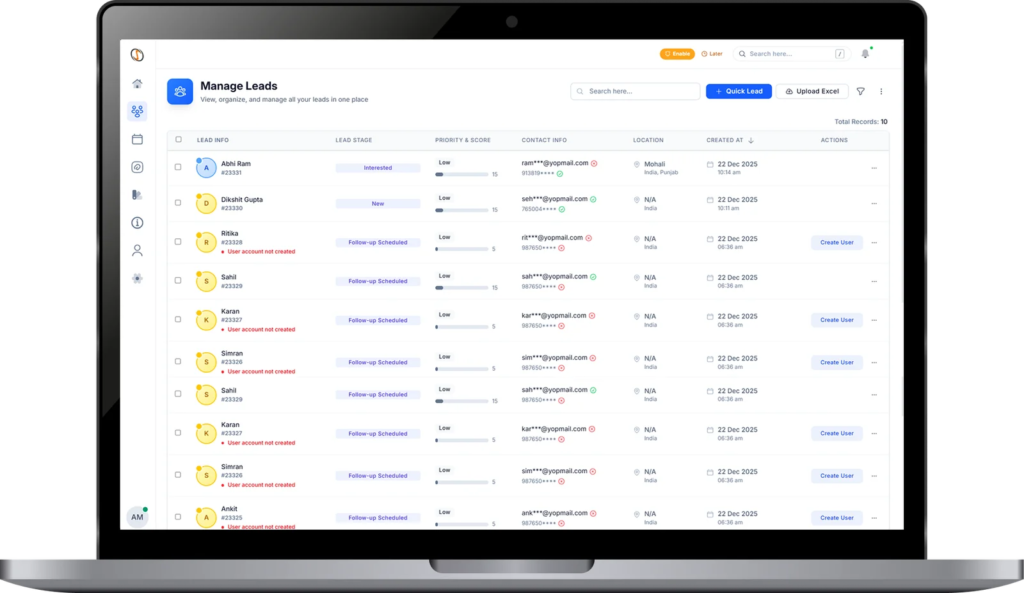
Institutions today receive student inquiries from multiple channels such as websites, social media, education fairs, walk-ins, digital agencies, and paid campaigns. Without a centralized student lead management system, these leads often result in leakage, duplication, and missed follow-ups.
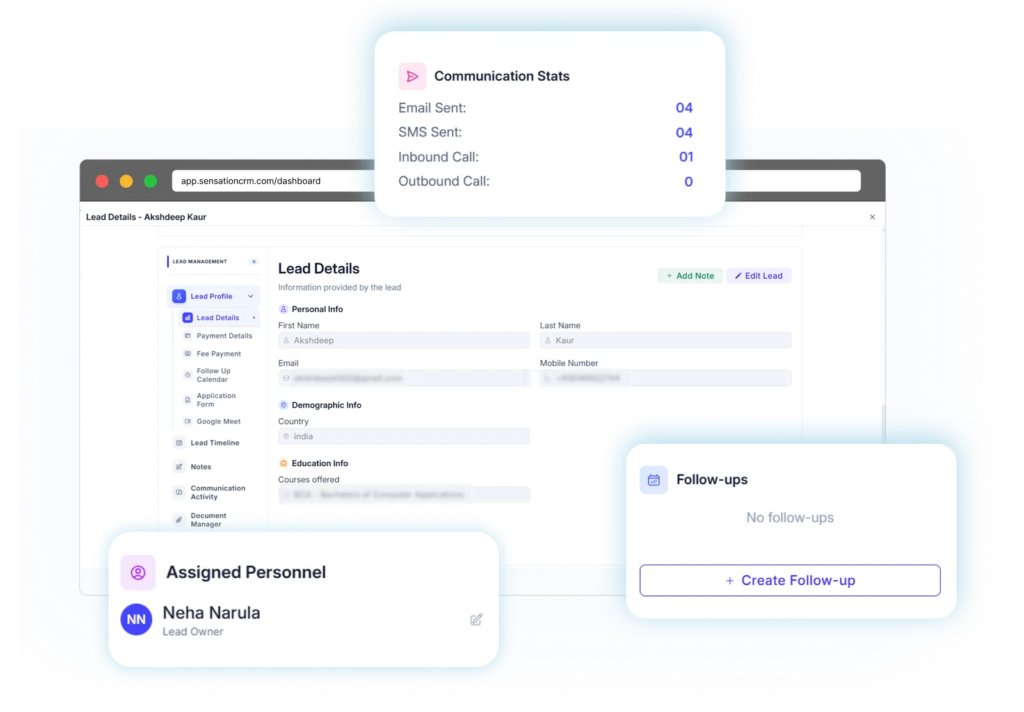
Sensation CRM addresses this challenge by consolidating all leads into a single platform for any online learning platform in India providing complete visibility and control, improving team accountability, and enabling faster, more coordinated action across departments.
Duplicate inquiries make it hard to track performance and inflate manual workload. Sensation CRM uses advanced source tracking and unique lead identification logic that:
Detects duplicates across channels
Shows unified lead management history across touch pointser
Prevents re-entry of the same inquiry
Improves data accuracy for reporting and action
Your counselors always know which lead to work on and who owns it.
Smart Lead Management Distribution Right Leads to Right Counsellors
Capturing leads isn’t enough. You need intelligent distribution so your team responds fast and contextually, supported by a structured student management system that ensures the right counsellors get the right leads with proper access and accountability.
This prevents bottlenecks and ensures follow-ups are fast, relevant, and precise.
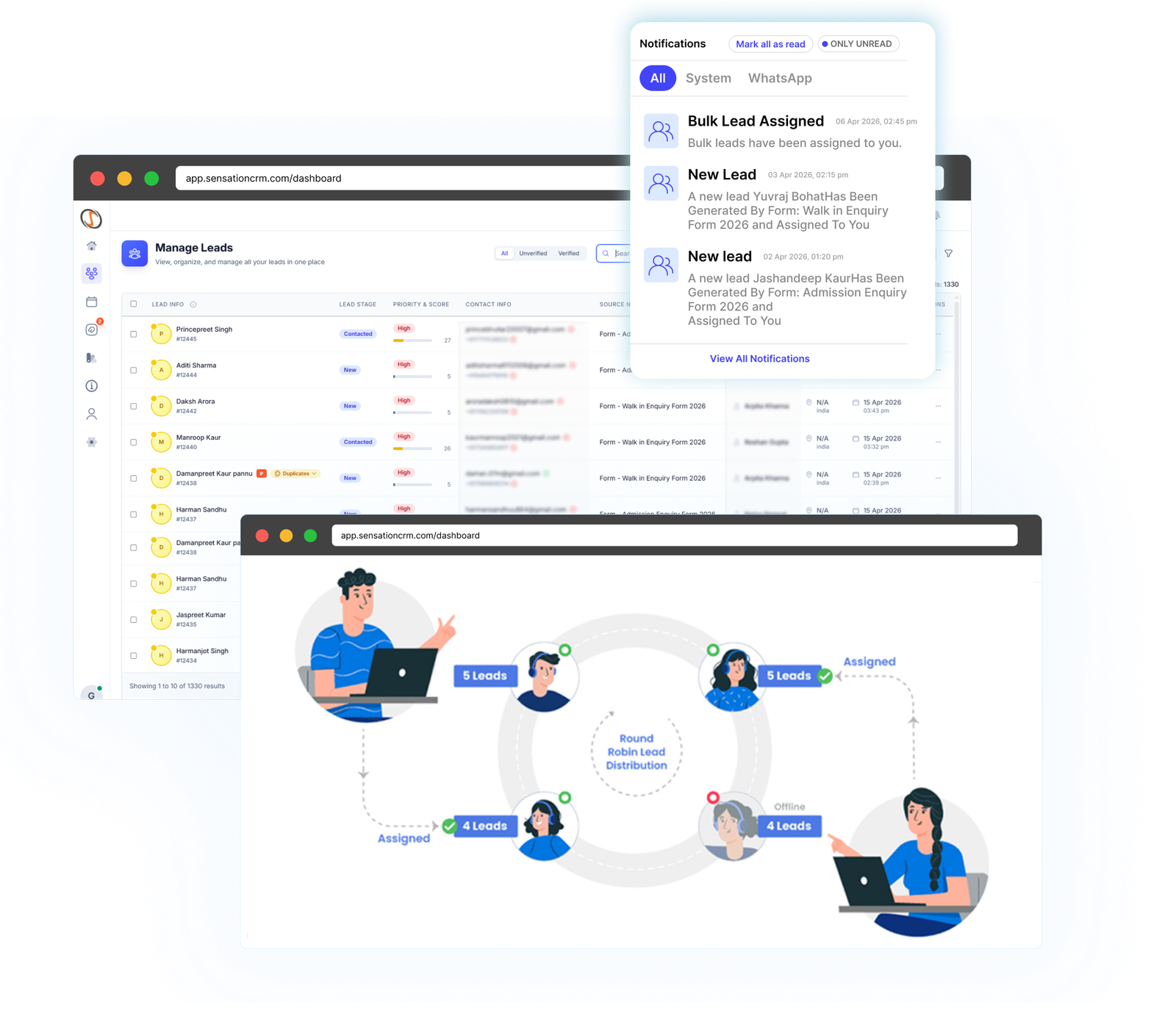
Round-Robin Allocation Balanced workload across your team.
Custom Logic Rules Assign by course, location, score, or campaign.
Automated Distribution No manual steps after setup.
Real-time Notifications Counselors get alerts immediately.
Unlike generic CRMs, Sensation CRM is a powerful Education CRM and education lead tracking system that understands the complete education ecosystem from inquiries to enrollments:
This exquisite compilation showcases a diverse array of photographs that capture the essence of different eras and cultures, reflecting the unique styles and perspectives of each artist.
How much does The Stories Book cost?
This exquisite compilation showcases a diverse array of photographs that capture the essence of different eras and cultures, reflecting the unique styles and perspectives of each artist.
When will The Stories Book be released?
This exquisite compilation showcases a diverse array of photographs that capture the essence of different eras and cultures, reflecting the unique styles and perspectives of each artist.
Are signed copies available?
This exquisite compilation showcases a diverse array of photographs that capture the essence of different eras and cultures, reflecting the unique styles and perspectives of each artist.
How AI- powered Sensation CRM’s help in Lead Management System?
Sensation CRM uses AI to automatically score, segment, and prioritize leads based on behavior, source, and engagement. This helps counselors focus on high-intent prospects, improving conversion rates and reducing manual effort.
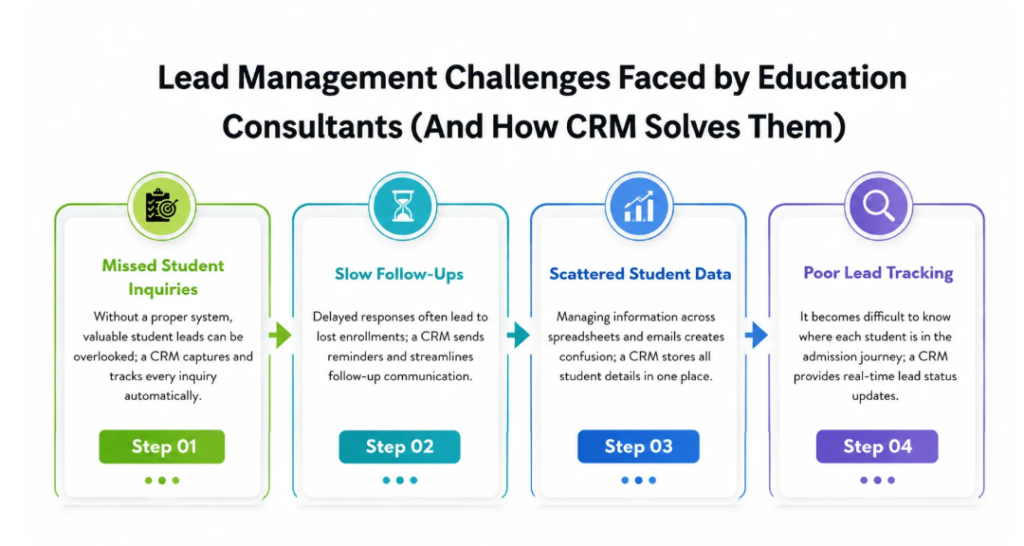
Lead Management Challenges Faced by Education Consultants (And How CRM Solves Them)
The Lead Management Challenges education sector in India is becoming more competitive every year. Schools, universities, coaching institutes, and education consultants receive inquiries from multiple channels such as websites, social media, WhatsApp, and education portals. Managing these leads efficiently has become a major challenge.
As inquiry volumes continue increasing, managing student communication manually is becoming difficult for many organizations. Delayed follow-ups, scattered data, missed counseling calls, duplicate inquiries, and inconsistent communication often reduce enrollment conversions and operational efficiency.
This growing complexity has increased the demand for structured Lead Management CRM systems and intelligent lead management software across the Indian education sector. Many institutions now use CRM platforms to manage inquiries from one place. These systems help counselors respond faster, automate routine tasks, and improve the admission process.
According to recent education technology trends in India, institutions implementing CRM-driven lead management processes often improve inquiry response speed and admission conversion rates because students increasingly expect fast, personalized, and digitally connected communication experiences.
Why Lead Management Has Become a Major Challenge for Education Consultants
Education consulting businesses operate in a communication-heavy environment where every inquiry represents a potential admission opportunity. During peak admission seasons, consultants often manage thousands of leads simultaneously across multiple channels.
Most organizations generate leads through:
Google Ads campaigns
Social media marketing
Organic website traffic
WhatsApp inquiries
Referral programs
Education portals
Seminars and webinars
Offline counseling events
Without a centralized lead management crm, tracking student interactions and follow-ups becomes extremely difficult.
Many organizations still depend on spreadsheets or disconnected tools that cannot support modern admission workflows efficiently. This often creates communication gaps, operational confusion, and reduced conversion visibility.
What Are Common Lead Management Challenges?
One of the most common questions education businesses ask is: “What are common lead management challenges?”
Educational consultants across India frequently struggle with operational inefficiencies while managing large inquiry pipelines.
Delayed Lead Response Time
Imagine a student submitting inquiries to three overseas education consultants. If one consultant responds within five minutes while another takes two days, the student is far more likely to continue the conversation with the faster responder.
Scattered Student Data
Many organizations manage student information across spreadsheets, emails, WhatsApp chats, and separate communication platforms. This creates fragmented records and makes it difficult for counselors to track student history, previous interactions, and application progress accurately.
Poor Follow-Up Management
Consistent follow-up remains one of the biggest challenges in lead generation in India for education businesses. Counselors handling large inquiry volumes often miss reminders, callbacks, or long-term nurturing opportunities. Without automation systems, valuable inquiries frequently become inactive due to communication delays.
Duplicate Leads and Data Errors
Educational organizations generating inquiries from multiple platforms often face duplicate entries and inconsistent data collection. This affects reporting quality, counselor coordination, and operational decision-making.
Lack of Reporting Visibility
Management teams often struggle to monitor:
Counselor productivity
Conversion rates
Lead source performance
Follow-up quality
Marketing ROI
Without structured reporting dashboards, optimizing admission strategies becomes difficult.
What Is the Difference Between Lead Management and CRM?
Another common question businesses ask is: “What is the difference between lead management and CRM?”
Lead management specifically focuses on capturing, organizing, tracking, nurturing, and converting inquiries into enrollments or customers. CRM, or Customer Relationship Management, is a broader operational framework designed to manage complete customer interactions, communication workflows, reporting systems, automation processes, and long-term engagement.
In simple terms:
Lead management handles inquiry tracking and conversion workflows
CRM manages broader relationship and operational processes
A modern lead management crm combines both functionalities by supporting inquiry management while also maintaining long-term communication and student engagement history.
For educational organizations, CRM systems often become centralized platforms connecting admissions, counseling, communication, marketing, reporting, and workflow automation.
Why Education Consultants in India Are Adopting Lead Management CRM Systems
Educational organizations across India are increasingly investing in lead management software because student expectations and competition levels continue growing rapidly.
Students today expect:
Instant responses
Personalized counseling
Real-time communication
Fast document coordination
Multi-channel engagement
Managing these expectations manually becomes difficult as inquiry volumes increase.
Modern lead management software india solutions help organizations automate repetitive tasks while improving communication consistency and operational efficiency. This allows counselors to focus more on student guidance and enrollment support rather than manual administrative coordination.
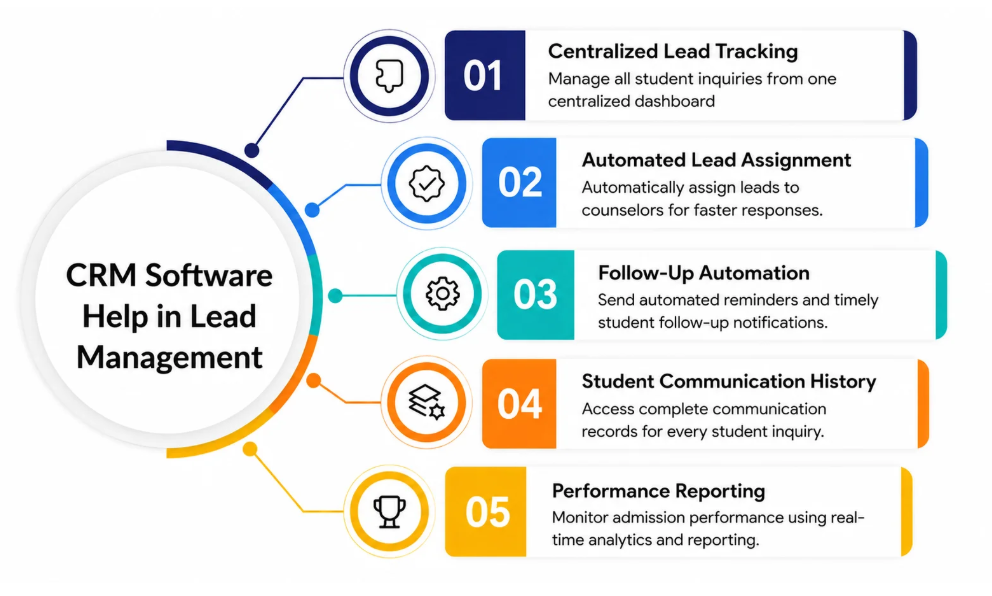
How Does CRM Software Help in Lead Management?
One of the most important operational questions businesses ask is: “How does CRM software help in lead management?”
Modern CRM systems streamline the complete inquiry lifecycle from lead generation to final enrollment.
Centralized Lead Tracking
CRM platforms collect inquiries from websites, social media campaigns, advertisements, WhatsApp, webinars, and offline campaigns into one centralized dashboard.
This improves visibility and reduces communication gaps across teams.
Automated Lead Assignment
Lead management software automatically assigns inquiries to counselors based on:
Course interest
Branch preference
Location
Availability
Inquiry priority
This improves response speed and operational coordination.
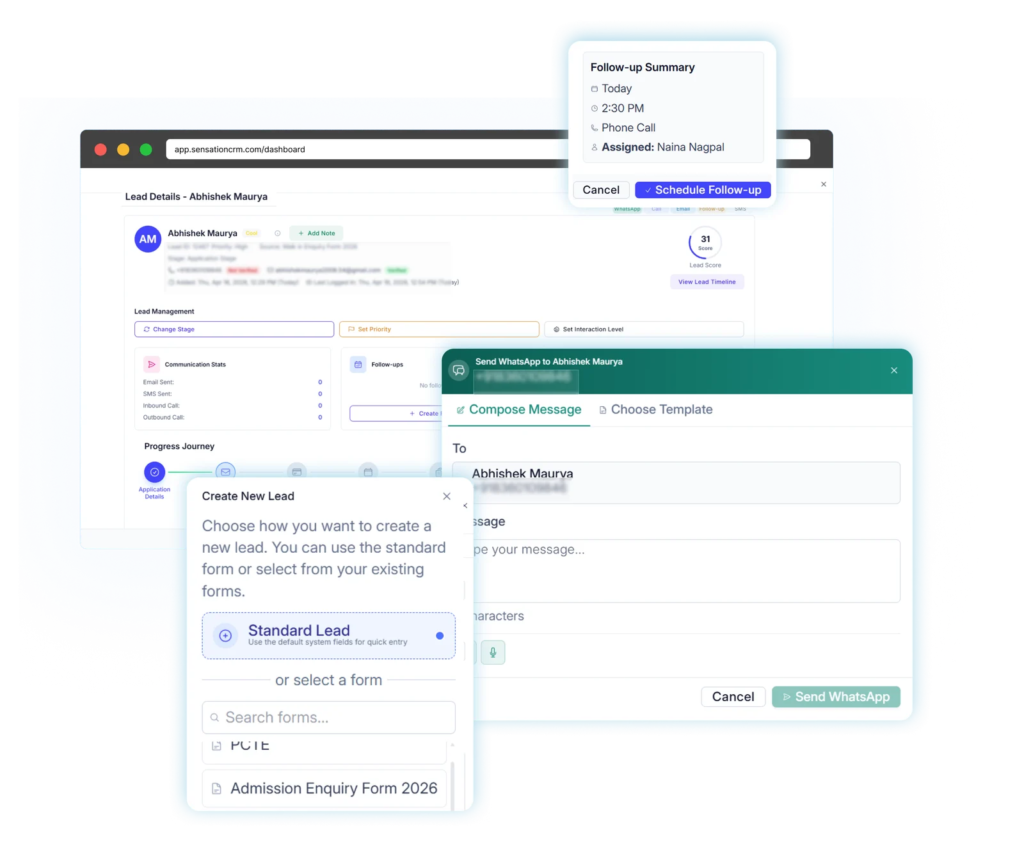
Follow-Up Automation
Automated reminders, email workflows, WhatsApp notifications, and counseling schedules help consultants maintain consistent communication with students.
Automation significantly reduces missed follow-ups and inactive leads.
Student Communication History
CRM systems maintain complete interaction records including:
Calls
Emails
WhatsApp conversations
Counseling notes
Application updates
This helps counselors personalize conversations more effectively.
Performance Reporting
CRM dashboards provide insights into:
Lead source performance
Counselor productivity
Conversion ratios
Follow-up trends
Marketing campaign performance
These reports help management teams improve operational planning and lead generation performance.
What Is the Lead Management Process in CRM?
Businesses frequently ask: “What is the lead management process in CRM?”
The lead management process usually follows several structured stages designed to improve inquiry handling and conversion tracking.
Lead Capture: The CRM collects inquiries from websites, ads, social media, WhatsApp, education portals, webinars, and offline campaigns.
Qualification Lead: The system categorizes students based on course interest, intent level, location, budget, and enrollment probability.
Lead Assignment: Qualified inquiries are assigned to appropriate counselors automatically or manually.
Follow-Up and Lead Nurturing: Counselors communicate with students through calls, emails, counseling sessions, webinars, and WhatsApp while tracking interactions inside the CRM.
Conversion Analysis: Management teams analyze inquiry performance, conversion trends, counselor productivity, and operational bottlenecks using reporting dashboards.
Why Lead Generation Services in India Need CRM Integration
Many educational organizations invest heavily in lead generation services in India but still struggle with low conversions because inquiry management workflows remain unorganized.
Lead generation alone is not enough. Institutions also require structured systems for:
Lead nurturing
Communication management
Follow-up automation
Conversion tracking
Inquiry prioritization
Without CRM integration, many generated leads eventually become inactive or untracked.
This is why lead generation and CRM systems increasingly operate together as connected operational strategies.
AI and Automation Are Changing Lead Management in India
AI-powered CRM systems are transforming how educational organizations manage inquiries and counseling operations.
Modern sales lead management software increasingly includes:
AI-based lead scoring
Automated WhatsApp communication
Predictive conversion analytics
Smart follow-up reminders
Behavioral inquiry analysis
Automated reporting systems
These features help organizations improve response quality while reducing repetitive administrative workload. AI-driven lead prioritization also helps counselors focus more effectively on high-intent inquiries.
Why Indian Education Consultants Prefer Custom CRM Solutions
Many organizations prefer customized CRM platforms instead of generic software because educational workflows differ significantly between institutions.
For example:
Overseas consultants manage visa workflows
Coaching institutes prioritize lead nurturing
Universities manage multi-department admissions
Edtech companies focus heavily on digital engagement
Custom CRM solutions allow businesses to build workflows aligned with operational requirements instead of adapting processes to rigid software limitations.
Comparison Between Manual Lead Tracking and CRM-Based Lead Management
Feature
Manual Lead Tracking
Lead Management CRM
Inquiry Organization
Scattered
Centralized
Follow-Up Management
Manual
Automated
Reporting Visibility
Limited
Real-time dashboards
Lead Assignment
Unorganized
Automated workflows
Communication Tracking
Difficult
Complete history
Conversion Monitoring
Inconsistent
Structured analytics
Scalability
Limited
Highly scalable
Future of Lead Management in the Indian Education Sector
The Indian education industry is becoming increasingly digital, communication-driven, and competitive. Educational organizations are expected to continue investing heavily in CRM platforms, automation systems, AI-powered engagement tools, and centralized inquiry management infrastructure.
Future trends are likely to include:
AI-powered counseling automation
WhatsApp-first communication systems
Predictive enrollment analytics
Voice-assisted CRM platforms
Automated student engagement workflows
Multi-campus CRM management
As student expectations continue evolving, educational organizations will increasingly depend on intelligent lead management systems to improve operational efficiency and admission performance.
Organizations exploring scalable inquiry management solutions can also learn more about professional Lead Management CRM Solutions designed specifically for education-focused counseling workflows, admission automation, and student engagement management.
Frequently Asked Questions
What are common lead management challenges?
Common challenges include delayed responses, poor follow-up tracking, scattered student data, duplicate leads, communication gaps, and lack of reporting visibility.
What is the difference between lead management and Sensation CRM?
Lead management focuses on inquiry tracking and conversions, while Sensation CRM manages broader customer relationships, communication workflows, automation, and operational processes.
How can a CRM improve lead management for education consultants?
Sensation CRM software centralizes inquiries, automates follow-ups, tracks communication history, improves counselor coordination, and provides real-time analytics dashboards.
What is the lead management process in CRM?
The process typically includes lead capture, qualification, assignment, follow-up, nurturing, enrollment tracking, and conversion analysis.
Education CRM vs ERP is an important topic for educational institutions. This specialized customer relationships software helps manage academic, financial, administrative, and operational processes. student inquiries, admissions, communication and relationships. On the other hand a standard ERP manages academic,financial,administrative and operatinal processes. Consquently ,both helps schools and colleges choose the right system. Both Education CRM and ERP improve efficiency, but they serve different purposes and work together to enhance educational management.
Both systems help schools improve productivity and reduce manual work significantly. However, they serve entirely different purposes in daily administration. Using these both platforms together enhances student management, streamlines daily operations, and supports better decision-making for educational institutions. Therefore, integrating them is the best approach for long-term growth.
Lost student inquiries
Delayed follow-ups
Disconnected data
Inefficient communication
Limited visibility into admissions performance
Operational bottlenecks
Q1. How does Education CRM improve student engagement? Answer: It helps schools communicate with students through emails, calls, messages, and follow-ups.
Q2. How does ERP improve school management? Answer: ERP automates daily tasks such as attendance, fee collection, timetables, and report generation.
Q3. Who uses Education CRM in a school? Answer: Admission counselors, marketing teams, and administrative staff mainly use Education CRM.
Q4. Who uses ERP in a school? Answer: Teachers, accountants, administrators, and school management use ERP for daily operations.
Q5. What is the benefit of integrating CRM with ERP? Answer: Integration provides smooth data flow, saves time, and improves overall school efficiency.
Differences: Education CRM and ERP
Summary These both play an important role in improving school management. While CRM focuses on student communication, admissions, and engagement, ERP handles academic and administrative operations such as attendance, fees, examinations, and reports. Together, these systems reduce manual work, improve accuracy, and save time for schools. Choosing the right solution depends on the institution’s needs, but using both CRM and ERP together can increase efficiency, enhance the student experience, and support better decision-making for long-term educational success and academic operations.
Educational CRM today manage far more than admissions and academic records. Schools, colleges, universities, coaching centres, and education consultancies must handle student inquiries, admissions, communication, fee collection, academic operations, marketing campaigns, reporting, and stakeholder engagement simultaneously.
As institutions become increasingly digital, two software categories often dominate technology discussions: Education CRM and ERP systems. While both platforms help streamline operations, they serve very different purposes.
Many institutions searching for the right technology solution often ask whether they need a CRM, an ERP, or both. Understanding the differences between these systems is essential for making informed decisions that support student recruitment, operational efficiency, and long-term institutional growth. Implementing the right education CRM software can help institutions streamline admissions, improve student engagement, and enhance enrollment outcomes.
Why Education CRM Need Digital Management Systems
The modern student journey begins long before enrollment. Prospective students interact with websites, social media platforms, education portals, WhatsApp, email campaigns, webinars, and counselors before making admission decisions.
At the same time, institutions must manage academics, finance, examinations, attendance, faculty operations, student records, and administrative processes.
Managing these functions manually often leads to:
Lost student inquiries
Delayed follow-ups
Disconnected data
Inefficient communication
Limited visibility into admissions performance
Operational bottlenecks
This is where technologies like education CRM software and ERP systems help institutions centralize processes and improve efficiency.
What Is CRM for Education?
This is one of the most common questions educational institutions ask.
A Customer Relationship Management (CRM) system designed for education focuses primarily on student recruitment, admissions, communication, lead management, and relationship building.
An education CRM helps institutions manage prospective student interactions from the first inquiry through enrollment and beyond.
Unlike traditional business CRMs, a CRM for education industry is specifically designed to support admission workflows, student engagement, counselor management, marketing campaigns, and enrollment tracking. Understanding CRM for education features & checklist helps institutions select the right solution to streamline admissions and improve enrollment outcomes.
Educational institutions use CRM software to:
Capture inquiries from multiple channels
Automate follow-ups
Track admission pipelines
Manage counsellor activities
Monitor marketing ROI
Improve student communication
Increase enrollment conversions
A CRM focuses on helping institutions attract, engage, nurture, and convert prospective students more effectively.
What Is an ERP System in Education?
An Enterprise Resource Planning (ERP) system focuses on managing internal institutional operations. While CRM manages prospective student relationships, ERP manages the administrative and academic processes that occur after enrollment.
Educational ERP systems typically centralize:
Student records
Attendance management
Examination systems
Fee management
Human resources
Payroll
Timetable scheduling
Academic reporting
Library management
Faculty administration
ERP platforms are designed to improve operational efficiency by integrating multiple internal departments into a unified system.
Education CRM vs ERP: Understanding the Core Difference
Although CRM and ERP systems often work together, their primary objectives are different.
Feature
Education CRM
Education ERP
Primary Focus
Student acquisition and admissions
Academic and administrative management
User Group
Admission teams, marketing teams, counselors
Faculty, administration, finance, HR
Inquiry Management
Yes
Limited
Lead Tracking
Yes
No
Marketing Automation
Yes
No
Student Communication
Extensive
Basic
Academic Operations
Limited
Yes
Attendance Management
No
Yes
Examination Management
No
Yes
Fee Management
Limited
Yes
Enrollment Analytics
Yes
Limited
Internal Administration
No
Yes
The simplest way to understand the difference is:
CRM helps institutions acquire students. ERP helps institutions manage students after enrollment.
Which Is Better CRM or ERP?
Another frequently searched question is:
Which Is Better CRM or ERP?
The answer depends entirely on the institution’s goals.
If your primary challenge involves generating inquiries, improving admissions, increasing enrollment conversions, and managing communication, a CRM is often the higher priority.
If your institution struggles with academic administration, student records, examinations, fee collection, and internal operations, an ERP may be more critical.
However, for most growing educational institutions, the question is not CRM versus ERP.
The real question is how both systems can work together to support the complete student lifecycle.
A CRM manages the pre-admission journey, while an ERP manages the post-admission experience.
Can ERP Replace CRM?
Many institutions assume that because ERP systems contain student information, they can eliminate the need for a CRM.
Can ERP Replace CRM?
In most cases, no.
ERP systems focus mainly on academic and operational management, whereas student acquisition, engagement and lead nurturing are better managed through an education CRM.
While some ERP platforms include basic communication features, they often lack advanced capabilities such as:
Lead capture automation
Admission funnel tracking
Marketing campaign management
Lead scoring
Counselor activity monitoring
Enrollment conversion reporting
Multi-channel communication workflows
These functions are central to modern admissions management and are typically handled more effectively through dedicated CRM platforms.
Does an ERP Include a CRM?
Some ERP providers offer basic CRM functionality within their platforms. However, these modules are usually limited compared to specialized education CRM solutions.
A built-in CRM module may allow institutions to record inquiries and manage basic communication, but advanced features such as automation, marketing attribution, AI-driven lead scoring, and enrollment analytics are often missing.
As competition for student recruitment increases, many institutions choose specialized CRM platforms to gain greater visibility into admissions performance and marketing effectiveness.
What Are the Five ERP Modules?
While ERP systems vary by provider, most educational ERP platforms include five core modules:
Student Information Management: This module manages student profiles, enrollment records, academic history, and institutional data.
Finance and Fee Management: Finance modules support fee collection, accounting, invoicing, budgeting, and financial reporting.
Human Resources Management: HR functionality manages employee records, recruitment, payroll, attendance, and performance tracking.
Academic Management: Academic modules support timetables, examinations, grading systems, curriculum planning, and faculty operations.
Administration and Reporting: Administrative modules provide reporting dashboards, operational analytics, compliance monitoring, and institutional performance insights.
Together, these modules create a centralized operational ecosystem for educational institutions.
Why Education CRM Is Becoming More Important in 2026
Student recruitment has become increasingly competitive across schools, colleges, universities, and education businesses. Prospective students expect personalized communication, immediate responses, and seamless digital experiences throughout the admission process.
Research consistently shows that institutions responding quickly to inquiries achieve significantly higher conversion rates than those relying on delayed manual follow-up processes.
As a result, educational institutions are investing heavily in CRM technologies that support admission automation, lead management, marketing attribution, AI-powered engagement, and student communication workflows.
The growing importance of digital-first recruitment strategies is making CRM software one of the most valuable technology investments for modern educational organizations.
How Sensation CRM Helps Educational Institutions
For institutions seeking a specialized solution for admissions and student engagement, Sensation CRM provides a purpose-built platform designed specifically for the education sector.
Unlike generic CRM platforms originally developed for corporate sales teams, Sensation CRM focuses on education-specific workflows and enrollment management processes.
The platform helps institutions:
Capture inquiries from multiple sources
Automate admission follow-ups
Manage counselor activities
Track student communication
Measure marketing campaign performance
Monitor enrollment conversion rates
Improve lead response times
Generate admission reports and analytics
By centralizing admissions and student engagement activities, Sensation CRM enables institutions to create more efficient recruitment processes while improving student experiences.
Do Educational Institutions Need Both CRM and ERP?
For many institutions, the most effective approach is not choosing between CRM and ERP but implementing both technologies strategically.
CRM platforms support student recruitment, admissions, communication, and engagement before enrollment. ERP systems support academics, finance, administration, and operational management after enrollment.
Together, they provide a complete technology ecosystem that supports the entire student lifecycle from first inquiry to graduation.
Institutions that successfully integrate CRM and ERP systems often achieve stronger enrollment outcomes, improved operational efficiency, and better student experiences.
Why Indian Colleges and Universities Are Investing in Education CRM Software
The education sector in India has become significantly more competitive over the past few years. Private universities, engineering colleges, management institutes, online learning platforms, coaching centers, and international education consultants are all competing for student attention across digital channels.
With the implementation of the National Education Policy (NEP) and the rapid growth of digital admissions, institutions can no longer depend solely on traditional recruitment methods. Students expect quick responses, personalized communication, online counseling sessions, and seamless application experiences.
As a result, educational institutions across India are increasingly adopting education CRM software to streamline admissions, improve student engagement, and gain better visibility into recruitment performance. Institutions that leverage CRM platforms are often able to respond faster to inquiries, nurture leads more effectively, and improve enrollment outcomes. Book a free demo today to see how an education CRM can transform your admission and enrollment processes.
How AI Is Transforming Education CRM Software in 2026
Artificial Intelligence is rapidly changing how colleges and universities manage admissions and student engagement. Modern CRM platforms are no longer limited to storing contact information and tracking inquiries. They now provide intelligent automation capabilities that help admission teams work more efficiently.
AI-powered education CRM software can automatically score leads based on student behavior, identify high-intent applicants, personalize communication workflows, and recommend the next best action for counselors.
Educational institutions are increasingly using AI to:
Predict enrollment probability
Automate counselor assignment
Trigger personalized follow-up campaigns
Identify inactive prospects
Analyze recruitment channel performance
Improve response times
Generate admission reports automatically
According to industry research from Gartner, organizations implementing AI-powered CRM systems can significantly improve operational efficiency and customer engagement through automation and predictive analytics.
For colleges and universities managing thousands of inquiries annually, AI-driven CRM platforms provide a measurable competitive advantage.
Education Technology Market Growth
The global education technology market continues to expand rapidly as institutions increase investments in digital transformation initiatives. Industry reports estimate that the EdTech sector will surpass hundreds of billions of dollars in market value over the next decade, driven by growing demand for online learning, student engagement technologies, automation platforms, and data-driven admissions systems.
At the same time, CRM adoption within higher education continues rising as institutions seek better ways to manage recruitment, improve enrollment outcomes, and personalize student communication at scale.
Which One to Choose – CRM or ERP?
The debate between CRM and ERP is not about choosing one over the other. Both systems address different aspects of institutional success.
An education CRM helps attract, nurture, and convert prospective students, while an ERP manages the operational and academic processes that support enrolled students. Contact us today to learn how the right solution can help your institution improve efficiency and drive sustainable growth.
For institutions focused on improving admissions, lead management, communication, and enrollment performance, CRM often delivers the fastest measurable impact. Meanwhile, ERP systems remain essential for academic administration and internal operations.
Organizations looking to improve student recruitment and admission efficiency can explore Sensation CRM, a specialized solution designed to help educational institutions streamline admissions, manage inquiries, automate communication, and improve enrollment outcomes.
Educational institutions today manage far more than admissions and academic records. Schools, colleges, universities, coaching centres, and education consultancies must handle student inquiries, admissions, communication, fee collection, academic operations, marketing campaigns, reporting, and stakeholder engagement simultaneously.
As institutions become increasingly digital, two software categories often dominate technology discussions: Education CRM and ERP systems. While both platforms help streamline operations, they serve very different purposes.
Many institutions searching for the right technology solution often ask whether they need a CRM, an ERP, or both. Understanding the differences between these systems is essential for making informed decisions that support student recruitment, operational efficiency, and long-term institutional growth. Implementing the right education CRM software can help institutions streamline admissions, improve student engagement, and enhance enrollment outcomes.
Why Educational Institutions Need Digital Management Systems
The modern student journey begins long before enrollment. Prospective students interact with websites, social media platforms, education portals, WhatsApp, email campaigns, webinars, and counselors before making admission decisions.
At the same time, institutions must manage academics, finance, examinations, attendance, faculty operations, student records, and administrative processes.
Managing these functions manually often leads to:
Lost student inquiries
Delayed follow-ups
Disconnected data
Inefficient communication
Limited visibility into admissions performance
Operational bottlenecks
This is where technologies like education CRM software and ERP systems help institutions centralize processes and improve efficiency.
This is one of the most common questions educational institutions ask.
A Customer Relationship Management (CRM) system designed for education focuses primarily on student recruitment, admissions, communication, lead management, and relationship building.
An education CRM helps institutions manage prospective student interactions from the first inquiry through enrollment and beyond.
Unlike traditional business CRMs, a CRM for education industry is specifically designed to support admission workflows, student engagement, counselor management, marketing campaigns, and enrollment tracking. Understanding CRM for education features & checklist helps institutions select the right solution to streamline admissions and improve enrollment outcomes.
Educational institutions use CRM software to:
Capture inquiries from multiple channels
Automate follow-ups
Track admission pipelines
Manage counsellor activities
Monitor marketing ROI
Improve student communication
Increase enrollment conversions
A CRM focuses on helping institutions attract, engage, nurture, and convert prospective students more effectively.
What Is an ERP System in Education?
An Enterprise Resource Planning (ERP) system focuses on managing internal institutional operations. While CRM manages prospective student relationships, ERP manages the administrative and academic processes that occur after enrollment.
Educational ERP systems typically centralize:
Student records
Attendance management
Examination systems
Fee management
Human resources
Payroll
Timetable scheduling
Academic reporting
Library management
Faculty administration
ERP platforms are designed to improve operational efficiency by integrating multiple internal departments into a unified system.
Education CRM vs ERP: Understanding the Core Difference
Although CRM and ERP systems often work together, their primary objectives are different.
Feature
Education CRM
Education ERP
Primary Focus
Student acquisition and admissions
Academic and administrative management
User Group
Admission teams, marketing teams, counselors
Faculty, administration, finance, HR
Inquiry Management
Yes
Limited
Lead Tracking
Yes
No
Marketing Automation
Yes
No
Student Communication
Extensive
Basic
Academic Operations
Limited
Yes
Attendance Management
No
Yes
Examination Management
No
Yes
Fee Management
Limited
Yes
Enrollment Analytics
Yes
Limited
Internal Administration
No
Yes
The simplest way to understand the difference is:
CRM helps institutions acquire students. ERP helps institutions manage students after enrollment.
Which Is Better CRM or ERP?
Another frequently searched question is:
Which Is Better CRM or ERP?
The answer depends entirely on the institution’s goals.
If your primary challenge involves generating inquiries, improving admissions, increasing enrollment conversions, and managing communication, a CRM is often the higher priority.
If your institution struggles with academic administration, student records, examinations, fee collection, and internal operations, an ERP may be more critical.
However, for most growing educational institutions, the question is not CRM versus ERP.
The real question is how both systems can work together to support the complete student lifecycle.
A CRM manages the pre-admission journey, while an ERP manages the post-admission experience.
Can ERP Replace CRM?
Many institutions assume that because ERP systems contain student information, they can eliminate the need for a CRM.
Can ERP Replace CRM?
In most cases, no.
ERP systems focus mainly on academic and operational management, whereas student acquisition, engagement and lead nurturing are better managed through an education CRM.
While some ERP platforms include basic communication features, they often lack advanced capabilities such as:
Lead capture automation
Admission funnel tracking
Marketing campaign management
Lead scoring
Counselor activity monitoring
Enrollment conversion reporting
Multi-channel communication workflows
These functions are central to modern admissions management and are typically handled more effectively through dedicated CRM platforms.
Does an ERP Include a CRM?
Some ERP providers offer basic CRM functionality within their platforms. However, these modules are usually limited compared to specialized education CRM solutions.
A built-in CRM module may allow institutions to record inquiries and manage basic communication, but advanced features such as automation, marketing attribution, AI-driven lead scoring, and enrollment analytics are often missing.
As competition for student recruitment increases, many institutions choose specialized CRM platforms to gain greater visibility into admissions performance and marketing effectiveness.
While ERP systems vary by provider, most educational ERP platforms include five core modules:
Student Information Management: This module manages student profiles, enrollment records, academic history, and institutional data.
Finance and Fee Management: Finance modules support fee collection, accounting, invoicing, budgeting, and financial reporting.
Human Resources Management: HR functionality manages employee records, recruitment, payroll, attendance, and performance tracking.
Academic Management: Academic modules support timetables, examinations, grading systems, curriculum planning, and faculty operations.
Administration and Reporting: Administrative modules provide reporting dashboards, operational analytics, compliance monitoring, and institutional performance insights.
Together, these modules create a centralized operational ecosystem for educational institutions.
Why Education CRM Is Becoming More Important in 2026
Student recruitment has become increasingly competitive across schools, colleges, universities, and education businesses. Prospective students expect personalized communication, immediate responses, and seamless digital experiences throughout the admission process.
Research consistently shows that institutions responding quickly to inquiries achieve significantly higher conversion rates than those relying on delayed manual follow-up processes.
As a result, educational institutions are investing heavily in CRM technologies that support admission automation, lead management, marketing attribution, AI-powered engagement, and student communication workflows.
The growing importance of digital-first recruitment strategies is making CRM software one of the most valuable technology investments for modern educational organizations.
How Sensation CRM Helps Educational Institutions
For institutions seeking a specialized solution for admissions and student engagement, Sensation CRM provides a purpose-built platform designed specifically for the education sector.
Unlike generic CRM platforms originally developed for corporate sales teams, Sensation CRM focuses on education-specific workflows and enrollment management processes.
The platform helps institutions:
Capture inquiries from multiple sources
Automate admission follow-ups
Manage counselor activities
Track student communication
Measure marketing campaign performance
Monitor enrollment conversion rates
Improve lead response times
Generate admission reports and analytics
By centralizing admissions and student engagement activities, Sensation CRM enables institutions to create more efficient recruitment processes while improving student experiences.
Do Educational Institutions Need Both CRM and ERP?
For many institutions, the most effective approach is not choosing between CRM and ERP but implementing both technologies strategically.
CRM platforms support student recruitment, admissions, communication, and engagement before enrollment. ERP systems support academics, finance, administration, and operational management after enrollment.
Together, they provide a complete technology ecosystem that supports the entire student lifecycle from first inquiry to graduation.
Institutions that successfully integrate CRM and ERP systems often achieve stronger enrollment outcomes, improved operational efficiency, and better student experiences.
Why Indian Colleges and Universities Are Investing in Education CRM Software
The education sector in India has become significantly more competitive over the past few years. Private universities, engineering colleges, management institutes, online learning platforms, coaching centers, and international education consultants are all competing for student attention across digital channels.
With the implementation of the National Education Policy (NEP) and the rapid growth of digital admissions, institutions can no longer depend solely on traditional recruitment methods. Students expect quick responses, personalized communication, online counseling sessions, and seamless application experiences.
As a result, educational institutions across India are increasingly adopting education CRM software to streamline admissions, improve student engagement, and gain better visibility into recruitment performance. Institutions that leverage CRM platforms are often able to respond faster to inquiries, nurture leads more effectively, and improve enrollment outcomes. Book a free demo today to see how an education CRM can transform your admission and enrollment processes.
How AI Is Transforming Education CRM Software in 2026
Artificial Intelligence is rapidly changing how colleges and universities manage admissions and student engagement. Modern CRM platforms are no longer limited to storing contact information and tracking inquiries. They now provide intelligent automation capabilities that help admission teams work more efficiently.
AI-powered education CRM software can automatically score leads based on student behavior, identify high-intent applicants, personalize communication workflows, and recommend the next best action for counselors.
Educational institutions are increasingly using AI to:
Predict enrollment probability
Automate counselor assignment
Trigger personalized follow-up campaigns
Identify inactive prospects
Analyze recruitment channel performance
Improve response times
Generate admission reports automatically
According to industry research from Gartner, organizations implementing AI-powered CRM systems can significantly improve operational efficiency and customer engagement through automation and predictive analytics.
For colleges and universities managing thousands of inquiries annually, AI-driven CRM platforms provide a measurable competitive advantage.
Education Technology Market Growth
The global education technology market continues to expand rapidly as institutions increase investments in digital transformation initiatives. Industry reports estimate that the EdTech sector will surpass hundreds of billions of dollars in market value over the next decade, driven by growing demand for online learning, student engagement technologies, automation platforms, and data-driven admissions systems.
At the same time, CRM adoption within higher education continues rising as institutions seek better ways to manage recruitment, improve enrollment outcomes, and personalize student communication at scale.
Which One to Choose – CRM or ERP?
The debate between CRM and ERP is not about choosing one over the other. Both systems address different aspects of institutional success.
An education CRM helps attract, nurture, and convert prospective students, while an ERP manages the operational and academic processes that support enrolled students. Contact us today to learn how the right solution can help your institution improve efficiency and drive sustainable growth.
For institutions focused on improving admissions, lead management, communication, and enrollment performance, CRM often delivers the fastest measurable impact. Meanwhile, ERP systems remain essential for academic administration and internal operations.
Organizations looking to improve student recruitment and admission efficiency can explore Sensation CRM, a specialized solution designed to help educational institutions streamline admissions, manage inquiries, automate communication, and improve enrollment outcomes.